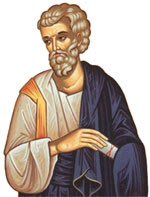
Saint John came from Bethsaida, a poor village in Galilee. He was the son of Zebedee the fisherman and of Salome, the daughter of Joseph, the Betrothed of the Virgin Mary. Joseph had four sons by his first marriage: James, Joses, Jude, and Simon (or Simeon), and three daughters: Esther, Martha, and Salome. Thus, Jesus Christ our Savior was the uncle of Saint John the Theologian, since He was the half-brother of John’s mother Salome.
John and his brother James were helping their father Zebedee with the fishing when the Savior called them to follow Him and become fishers of men. They immediately left everything to follow His heavenly teaching. Such was John’s love of virginity and ascesis that, above all the disciples, he was worthy of the name of “virgin,” and such his ardent love for Christ and irreproachable life that, among them all, he became the “beloved disciple.” He was one of the three closest to the Savior, who ascended Mount Tabor with Him. John looked upon the Divinity shining in the body of Christ and heard the voice out of the cloud that said: “This is my beloved Son in whom I am well pleased; listen to Him” (Matthew 17:5). It was John, carried away by his love, who wanted to sit at the right hand of the Lord in His Kingdom (Matthew 20:21). At the Last Supper, the Lord placed him at His side, where he leaned on the breast of his beloved Master (John 13:23). When the Jews laid hold of Jesus, Saint John followed Him into the palace of the high priest (John 18:15). He alone remained with the Virgin Mary at the foot of the Cross when the Savior was crucified. Seeing John standing by, Christ said to His mother: “Woman, behold your son!” and to John: “Behold your mother!” From that hour, John took the Virgin Mary into his own home (John 19:27).
At the time the Resurrection was announced, John outran Peter and came first to the Tomb. It was he who first stooped down and saw the linen cloths lying on the ground (John 20:5-6). He saw Christ after His Resurrection and was commissioned with the other disciples to preach the Gospel throughout the world when the Lord breathed on them as an earnest of the gift of the Holy Spirit (John 20:22). He was present also at the Lord’s Ascension into heaven and received the Holy Spirit under the appearance of tongues of fire with the other disciples on the day of Pentecost (Acts 1-2). He remained the last of them all in Jerusalem, in the company of the Virgin Mary, whom he served until the time of her Dormition.
When the time came to part from one another to preach in all the regions of the world, the Apostles drew lots to tell where each should go. It fell to John to preach the Gospel in Asia Minor which was full of idolatry and entirely given over to paganism. Saint John was much cast down on learning where he was to go for he had not yet learned to put all his trust in the invincible power of God. To purge him of this human weakness, God put him to the trial of wind and waves for forty days before he reached his destination. During this tempest, John’s disciple, the deacon Prochorus (July 28), was cast by the waves upon the shore at Seleucia where the people of the city accused him of witchcraft, suspecting him of having spirited away money from the shipwrecked vessel. He manged to escape, and after forty days found his master whom the sea had brought to shore at Marmareota, another city of Asia Minor.
They made their way to Ephesus, a place where the people had great devotion to the goddess Diana and would celebrate festivals in her honor. At one of these, John climbed the hill where stood the great statue of the goddess in order to address the crowd. The pagans were enraged to see him there and tried to stone him, but by the grace of God all the stones missed their mark and struck the statue, which was reduced to rubble. But the pagans, blind to the signs of divine Providence and deaf to the words of Saint John, made a second attempt to stone him. This time the stones turned back on the idolaters themselves, and the earth, quaking at the Apostle’s prayer, suddenly swallowed up more than two hundred of them. The people who survived came to their senses at last. They begged John to intercede with God to deal mercifully with them and restore to life those who had perished. So, at the prayer of Saint John, all those people came forth from the bowels of the earth, venerated the Apostle and were baptized.
The Emperor Domitian (AD 81-96) heard of John’s renown and arranged to meet him. He was so enraged by the Apostle’s confidence that Christ is mightier than any worldly power that he banished him to the island of Patmos in the hope of reducing his influence. On the voyage there with Prochorus, John showed the kindness of God towards man by curing the dysentery of the soldiers escorting them. As soon as they arrived, he freed Apollonides, the son of Myron a local dignitary, of an impure spirit. This miracle, accompanied by the word of John, brought Myron’s entire household to faith in Christ and baptism; and a little later, the Governor of the island was also baptized.
While he was on Patmos, John received a letter from the Bishop of Athens, Dionysius the Areopagite (October 3) who was then ninety-nine years old. He praised John as the daystar of the Gospel and prophesied that he would soon be freed. Indeed when Trajan succeeded Nerva (AD 98), he recalled Saint John to Ephesus, to the great sorrow of the people of Patmos whom he had converted. John did not want to leave them unconsoled. Strengthened by a sign from heaven, he fasted with them for three days; then, accompanied by Prochorus, he went up into a mountain where he directed all the powers of his soul towards the Lord. Suddenly the sky was rent by fearful flashes of lightening and claps of thunder. Prochorus was overwhelmed and fell to the ground while John remained impassible in contemplation. He heard a voice like thunder proclaiming from the height of heaven: “In the beginning was the Word, and the Word was with God, and the Word was God” (John 1:1). Prochorus transcribed this message of salvation, revealed to John as was once the Law to Moses on Mount Sinai, but this time not for the Jews alone, but for all even to the ends of the earth.
It was also on Patmos that John wrote the New Testament book known as the Apocalypse or Revelation. John saw Christ, having the appearance of a young man whose “face was like the sun shining in full strength.” Reassuring John, who “fell at his feet as though dead,” the Lord said: “Fear not; I am the First and the Last; I am He that Lives and was dead; and behold, I am alive forevermore and have the keys of Death and of Hell. Write the things that you have seen, and the things which are, and the things which shall be hereafter” (Revelation 1:17ff). Then in successive revelations John was shown what will happen at the end of time: the gathering strength of iniquity, the coming of the Antichrist, his warfare against the faithful and his final struggle against Christ who, in the end, will cast him forever into Hell with the Devil and his angels. It was also given him to see in his vision the violent upheavals that will take place in the world, the fiery end of all things, and the final triumph of the Son of man, the general Resurrection and the Last Judgment.
After his time on the island of Patmos, the Apostle John returned to Ephesus where he spent the remainder of his days in peace, bringing many to the faith. He was fifty-six when he left Jerusalem to preach the Gospel, which he did for nine years until his exile. He spent fifteen years on Patmos and lived another twenty-six years after his return to Ephesus.
http://www.goarch.org/en/special/listen_learn_share/johntheapostle/learn/
Friday, September 26, 2008

Wednesday, September 24, 2008
INTRODUCTION TO THE JESUS PRAYER
by H.R.H. Princess Ileana of Romania
"
Lord Jesus Christ, Son of God, have mercy upon me, a sinner.
I have often read the Jesus Prayer in prayer books and heard it in church, but my attention was drawn to it first some years ago in Romania. There in a small Monastery of Sâmbata, tucked away at the foot of the Carpathians in the heart of the deep forest, its little white church reflected in a crystal-clear mountain pond, I met a monk who practiced the "prayer of the heart". Profound peace and silence reigned at Sâmbata in those days; it was a place of rest and strength—I pray God it still is.
I have wandered far since I last saw Sâmbata, and all the while the Jesus Prayer lay as a precious gift buried in my heart. It remained inactive until a few years ago, when I read The Way of a Pilgrim. Since then I have been seeking to practice it continually. At times I lapse; nonetheless, the prayer has opened unbelievable vistas within my heart and soul.
The Jesus Prayer, or the Prayer of the Heart, centers on the Holy Name itself. It may be said in its entirety: "Lord Jesus Christ, Son of God, have mercy upon me, a sinner;" it may be changed to "us sinners" or to other persons named, or it may be shortened. The power lies in the name of Jesus; thus "Jesus," alone, may fulfill the whole need of the one who prays.
The Prayer goes back to the New Testament and has had a long, traditional use. The method of contemplation based upon the Holy Name is attributed to St. Simeon, called the "New Theologian" (949-1022). When he was 14 years old, St. Simeon had a vision of heavenly light in which he seemed to be separated from his body. Amazed, and overcome with an overpowering joy, he felt a consuming humility, and cried, borrowing the Publican's prayer (Luke 18:13), "Lord Jesus, have mercy upon me." Long after the vision had disappeared, the great joy returned to St. Simeon each time he repeated the prayer; and he taught his disciples to worship likewise. The prayer evolved into its expanded form: "Lord Jesus Christ, Son of God, have mercy upon me, a sinner." In this guise it has come down to us from generation to generation of pious monks and laymen.
The invocation of the Holy Name is not peculiar to the Orthodox Church but is used by Roman Catholics, Anglicans, and Protestants, though to a lesser degree. On Mount Sinai and Athos the monks worked out a whole system of contemplation based upon this simple prayer, practiced in complete silence. These monks came to be known as "Quietists" (in Greek: "Hesychasts").
St. Gregory Palamas (1296-1359), the last of the great Church Fathers, became the exponent of the Hesychasts. He won, after a long drawn out battle, an irrefutable place for the Jesus Prayer and the Quietists within the Church. In the 18th century when tsardom hampered monasticism in Russia, and the Turks crushed Orthodoxy in Greece, the Neamtzu monastery in Moldavia (Romania) became one of the great centers for the Jesus Prayer.
The Prayer is held to be so outstandingly spiritual because it is focused wholly on Jesus: all thoughts, striving, hope, faith and love are outpoured in devotion to God the Son. It fulfills two basic injunctions of the New Testament. In one, Jesus said: "I say unto you, Whatsoever ye shall ask the Father in my name, he will give it you. Hitherto have ye asked nothing in my name: ask, and ye shall receive, that your joy may be full" (John 16: 23, 24). In the other precept we find St. Paul's injunction to pray without ceasing, (1. Thess. 5:17). Further, it follows Jesus' instructions upon how to pray (which He gave at the same time He taught His followers the Lord's Prayer): "When thou prayest, enter into thy closet, and when thou hast shut thy door, pray to thy Father which is in secret; and thy Father which seeth in secret shall reward thee openly" (Matt. 6:6).
And Jesus taught that all impetus, good and bad, originates in men's hearts. "A good man out of the good treasure of his heart bringeth forth that which is good; and an evil man out of the evil treasure of his heart bringeth forth that which is evil: for of the abundance of the heart his mouth speaketh" (Luke 6:45).
Upon these and many other precepts of the New Testament as well as the Old, the Holy Fathers, even before St. Simeon, based their fervent and simple prayer. They developed a method of contemplation in which unceasing prayer became as natural as breathing, following the rhythmic cadence of the heart beat.
All roads that lead to God are beset with pitfalls because the enemy (Satan) ever lies in wait to trip us up. He naturally attacks most assiduously when we are bent on finding our way to salvation, for that is what he most strives to hinder. In mystical prayer the temptations we encounter exceed all others in danger; because our thoughts are on a higher level, the allurements are proportionally subtler. Someone said that "mysticism started in mist and ended in schism"; this cynical remark, spoken by an unbeliever, has a certain truth in it. Mysticism is of real spiritual value only when it is practiced with absolute sobriety.
At one time a controversy arose concerning certain Quietists who fell into excessive acts of piety and fasting because they lost the sense of moderation upon which our Church lays so great a value. We need not dwell upon misuses of the Jesus Prayer, except to realize that all exaggerations are harmful and that we should at all times use self-restraint. "Practice of the Jesus Prayer is the traditional fulfillment of the injunction of the Apostle Paul to 'pray always:' it has nothing to do with the mysticism which is the heritage of pagan ancestry."
The Orthodox Church is full of deep mystic life which she guards and encompasses with the strength of her traditional rules; thus her mystics seldom go astray. "The 'ascetical life' is a life in which 'acquired' virtues, i.e. virtues resulting from a personal effort, only accompanied by that general grace which God grants to every good will, prevail. The 'mystical life' is a life in which the gifts of the Holy Spirit are predominant over human efforts, and in which 'infused' virtues are predominant over the 'acquired' ones; the soul has become more passive than active. Let us use a classical comparison. Between the ascetic life, that is, the life in which human action predominates, and the mystical life, that is, the life in which God's action predominates, there is the same difference as between rowing a boat and sailing it; the oar is the ascetic effort, the sail is the mystical passivity which is unfurled to catch the divine wind." The Jesus Prayer is the core of mystical prayer, and it can be used by anyone, at any time. There is nothing mysterious about this (let us not confuse "mysterious" with "mystic"). We start by following the precepts and examples frequently given by our Lord. First, go aside into a quiet place: "Come ye yourselves apart into a desert place, and rest awhile" (Mark 6:31); "Study to be quiet" (I. Thess. 4: 11); then pray in secret—alone and in silence.
The phrases "to pray in secret, alone and in silence" need, I feel, a little expanding. "Secret" should be understood as it is used in the Bible: for instance, Jesus tells us to do our charity secretly-not letting the left hand know what the right one does. We should not parade our devotions, nor boast about them. "Alone" means to separate ourselves from our immediate surroundings and disturbing influences. As a matter of fact, never are we in so much company as when we pray". . . seeing we also are compassed about with so great a cloud of witnesses. . ." (Hebrews 12:1). The witnesses are all those who pray: Angels, Archangels, saints and sinners, the living and the dead. It is in prayer, especially the Jesus Prayer, that we become keenly aware of belonging to the living body of Christ. In "silence" implies that we do not speak our prayer audibly. We do not even meditate on the words; we use them only to reach beyond them to the essence itself.
In our busy lives this is not easy, yet it can be done-we can each of us find a few minutes in which to use a prayer consisting of only a few words, or even only one. This prayer should be repeated quietly, unhurriedly, thoughtfully. Each thought should be concentrated on Jesus, forgetting all else, both joys and sorrows. Any stray thought, however good or pious, can become an obstacle.
When you embrace a dear one you do not stop to meditate how and why you love—you just love wholeheartedly. It is the same when spiritually we grasp Jesus the Christ to our heart. If we pay heed to the depth and quality of our love, it means that we are preoccupied with our own reactions, rather than giving ourselves unreservedly to Jesus —holding nothing back. Think the prayer as you breathe in and out; calm both mind and body, using as rhythm the heartbeat. Do not search for words, but go on repeating the Prayer, or Jesus' name alone, in love and adoration. That is ALL! Strange—in this little there is more than all!
It is good to have regular hours for prayer and to retire whenever possible to the same room or place, possibly before an icon. The icon is loaded with the objective presence of the One depicted, and thus greatly assists our invocation. Orthodox monks and nuns find that to use a rosary helps to keep the attention fixed. Or you may find it best quietly to close your eyes—focusing them inward.
The Jesus Prayer can be used for worship and petition; as intercession, invocation, adoration, and as thanksgiving. It is a means by which we lay all that is in our hearts, both for God and man, at the feet of Jesus. It is a means of communion with God and with all those who pray. The fact that we can train our hearts to go on praying even when we sleep, keeps us uninterruptedly within the community of prayer. This is no fanciful statement; many have experienced this life-giving fact. We cannot, of course, attain this continuity of prayer all at once, but it is achievable; for all that is worthwhile we must ". . . run with patience the race that is set before us . . ." (Hebrews 12:1).
I had a most striking proof of uninterrupted communion with all those who pray when I lately underwent surgery. I lay long under anesthesia. "Jesus" had been my last conscious thought, and the first word on my lips as I awoke. It was marvelous beyond words to find that although I knew nothing of what was happening to my body I never lost cognizance of being prayed-for and of praying myself. After such an experience one no longer wonders that there are great souls who devote their lives exclusively to prayer.
Prayer has always been of very real importance to me, and the habit formed in early childhood of morning and evening prayer has never left me; but in the practice of the Jesus Prayer I am but a beginner. I would, nonetheless, like to awaken interest in this prayer because, even if I have only touched the hem of a heavenly garment, I have touched it—and the joy is so great I would share it with others. It is not every man's way of prayer; you may not find in it the same joy that I find, for your way may be quite a different one—yet equally bountiful.
In fear and joy, in loneliness and companionship, it is ever with me. Not only in the silence of daily devotions, but at all times and in all places. It transforms, for me, frowns into smiles; it beautifies, as if a film had been washed off an old picture so that the colors appear clear and bright, like nature on a warm spring day after a shower. Even despair has become attenuated and repentance has achieved its purpose.
When I arise in the morning, it starts me joyfully upon a new day. When I travel by air, land, or sea, it sings within my breast. When I stand upon a platform and face my listeners, it beats encouragement. When I gather my children around me, it murmurs a blessing. And at the end of a weary day, when I lay me down to rest, I give my heart over to Jesus: "(Lord) into thy hands I commend my spirit". I sleep—but my heart as it beats prays on: "JESUS".
"
Its not very often that I can make a post both about spirituality and monarchy! I found this short work quite good and a great introduction to the Jesus prayer. From what I read, H.R.H. went on to become a nun.
"
Lord Jesus Christ, Son of God, have mercy upon me, a sinner.
I have often read the Jesus Prayer in prayer books and heard it in church, but my attention was drawn to it first some years ago in Romania. There in a small Monastery of Sâmbata, tucked away at the foot of the Carpathians in the heart of the deep forest, its little white church reflected in a crystal-clear mountain pond, I met a monk who practiced the "prayer of the heart". Profound peace and silence reigned at Sâmbata in those days; it was a place of rest and strength—I pray God it still is.
I have wandered far since I last saw Sâmbata, and all the while the Jesus Prayer lay as a precious gift buried in my heart. It remained inactive until a few years ago, when I read The Way of a Pilgrim. Since then I have been seeking to practice it continually. At times I lapse; nonetheless, the prayer has opened unbelievable vistas within my heart and soul.
The Jesus Prayer, or the Prayer of the Heart, centers on the Holy Name itself. It may be said in its entirety: "Lord Jesus Christ, Son of God, have mercy upon me, a sinner;" it may be changed to "us sinners" or to other persons named, or it may be shortened. The power lies in the name of Jesus; thus "Jesus," alone, may fulfill the whole need of the one who prays.
The Prayer goes back to the New Testament and has had a long, traditional use. The method of contemplation based upon the Holy Name is attributed to St. Simeon, called the "New Theologian" (949-1022). When he was 14 years old, St. Simeon had a vision of heavenly light in which he seemed to be separated from his body. Amazed, and overcome with an overpowering joy, he felt a consuming humility, and cried, borrowing the Publican's prayer (Luke 18:13), "Lord Jesus, have mercy upon me." Long after the vision had disappeared, the great joy returned to St. Simeon each time he repeated the prayer; and he taught his disciples to worship likewise. The prayer evolved into its expanded form: "Lord Jesus Christ, Son of God, have mercy upon me, a sinner." In this guise it has come down to us from generation to generation of pious monks and laymen.
The invocation of the Holy Name is not peculiar to the Orthodox Church but is used by Roman Catholics, Anglicans, and Protestants, though to a lesser degree. On Mount Sinai and Athos the monks worked out a whole system of contemplation based upon this simple prayer, practiced in complete silence. These monks came to be known as "Quietists" (in Greek: "Hesychasts").
St. Gregory Palamas (1296-1359), the last of the great Church Fathers, became the exponent of the Hesychasts. He won, after a long drawn out battle, an irrefutable place for the Jesus Prayer and the Quietists within the Church. In the 18th century when tsardom hampered monasticism in Russia, and the Turks crushed Orthodoxy in Greece, the Neamtzu monastery in Moldavia (Romania) became one of the great centers for the Jesus Prayer.
The Prayer is held to be so outstandingly spiritual because it is focused wholly on Jesus: all thoughts, striving, hope, faith and love are outpoured in devotion to God the Son. It fulfills two basic injunctions of the New Testament. In one, Jesus said: "I say unto you, Whatsoever ye shall ask the Father in my name, he will give it you. Hitherto have ye asked nothing in my name: ask, and ye shall receive, that your joy may be full" (John 16: 23, 24). In the other precept we find St. Paul's injunction to pray without ceasing, (1. Thess. 5:17). Further, it follows Jesus' instructions upon how to pray (which He gave at the same time He taught His followers the Lord's Prayer): "When thou prayest, enter into thy closet, and when thou hast shut thy door, pray to thy Father which is in secret; and thy Father which seeth in secret shall reward thee openly" (Matt. 6:6).
And Jesus taught that all impetus, good and bad, originates in men's hearts. "A good man out of the good treasure of his heart bringeth forth that which is good; and an evil man out of the evil treasure of his heart bringeth forth that which is evil: for of the abundance of the heart his mouth speaketh" (Luke 6:45).
Upon these and many other precepts of the New Testament as well as the Old, the Holy Fathers, even before St. Simeon, based their fervent and simple prayer. They developed a method of contemplation in which unceasing prayer became as natural as breathing, following the rhythmic cadence of the heart beat.
All roads that lead to God are beset with pitfalls because the enemy (Satan) ever lies in wait to trip us up. He naturally attacks most assiduously when we are bent on finding our way to salvation, for that is what he most strives to hinder. In mystical prayer the temptations we encounter exceed all others in danger; because our thoughts are on a higher level, the allurements are proportionally subtler. Someone said that "mysticism started in mist and ended in schism"; this cynical remark, spoken by an unbeliever, has a certain truth in it. Mysticism is of real spiritual value only when it is practiced with absolute sobriety.
At one time a controversy arose concerning certain Quietists who fell into excessive acts of piety and fasting because they lost the sense of moderation upon which our Church lays so great a value. We need not dwell upon misuses of the Jesus Prayer, except to realize that all exaggerations are harmful and that we should at all times use self-restraint. "Practice of the Jesus Prayer is the traditional fulfillment of the injunction of the Apostle Paul to 'pray always:' it has nothing to do with the mysticism which is the heritage of pagan ancestry."
The Orthodox Church is full of deep mystic life which she guards and encompasses with the strength of her traditional rules; thus her mystics seldom go astray. "The 'ascetical life' is a life in which 'acquired' virtues, i.e. virtues resulting from a personal effort, only accompanied by that general grace which God grants to every good will, prevail. The 'mystical life' is a life in which the gifts of the Holy Spirit are predominant over human efforts, and in which 'infused' virtues are predominant over the 'acquired' ones; the soul has become more passive than active. Let us use a classical comparison. Between the ascetic life, that is, the life in which human action predominates, and the mystical life, that is, the life in which God's action predominates, there is the same difference as between rowing a boat and sailing it; the oar is the ascetic effort, the sail is the mystical passivity which is unfurled to catch the divine wind." The Jesus Prayer is the core of mystical prayer, and it can be used by anyone, at any time. There is nothing mysterious about this (let us not confuse "mysterious" with "mystic"). We start by following the precepts and examples frequently given by our Lord. First, go aside into a quiet place: "Come ye yourselves apart into a desert place, and rest awhile" (Mark 6:31); "Study to be quiet" (I. Thess. 4: 11); then pray in secret—alone and in silence.
The phrases "to pray in secret, alone and in silence" need, I feel, a little expanding. "Secret" should be understood as it is used in the Bible: for instance, Jesus tells us to do our charity secretly-not letting the left hand know what the right one does. We should not parade our devotions, nor boast about them. "Alone" means to separate ourselves from our immediate surroundings and disturbing influences. As a matter of fact, never are we in so much company as when we pray". . . seeing we also are compassed about with so great a cloud of witnesses. . ." (Hebrews 12:1). The witnesses are all those who pray: Angels, Archangels, saints and sinners, the living and the dead. It is in prayer, especially the Jesus Prayer, that we become keenly aware of belonging to the living body of Christ. In "silence" implies that we do not speak our prayer audibly. We do not even meditate on the words; we use them only to reach beyond them to the essence itself.
In our busy lives this is not easy, yet it can be done-we can each of us find a few minutes in which to use a prayer consisting of only a few words, or even only one. This prayer should be repeated quietly, unhurriedly, thoughtfully. Each thought should be concentrated on Jesus, forgetting all else, both joys and sorrows. Any stray thought, however good or pious, can become an obstacle.
When you embrace a dear one you do not stop to meditate how and why you love—you just love wholeheartedly. It is the same when spiritually we grasp Jesus the Christ to our heart. If we pay heed to the depth and quality of our love, it means that we are preoccupied with our own reactions, rather than giving ourselves unreservedly to Jesus —holding nothing back. Think the prayer as you breathe in and out; calm both mind and body, using as rhythm the heartbeat. Do not search for words, but go on repeating the Prayer, or Jesus' name alone, in love and adoration. That is ALL! Strange—in this little there is more than all!
It is good to have regular hours for prayer and to retire whenever possible to the same room or place, possibly before an icon. The icon is loaded with the objective presence of the One depicted, and thus greatly assists our invocation. Orthodox monks and nuns find that to use a rosary helps to keep the attention fixed. Or you may find it best quietly to close your eyes—focusing them inward.
The Jesus Prayer can be used for worship and petition; as intercession, invocation, adoration, and as thanksgiving. It is a means by which we lay all that is in our hearts, both for God and man, at the feet of Jesus. It is a means of communion with God and with all those who pray. The fact that we can train our hearts to go on praying even when we sleep, keeps us uninterruptedly within the community of prayer. This is no fanciful statement; many have experienced this life-giving fact. We cannot, of course, attain this continuity of prayer all at once, but it is achievable; for all that is worthwhile we must ". . . run with patience the race that is set before us . . ." (Hebrews 12:1).
I had a most striking proof of uninterrupted communion with all those who pray when I lately underwent surgery. I lay long under anesthesia. "Jesus" had been my last conscious thought, and the first word on my lips as I awoke. It was marvelous beyond words to find that although I knew nothing of what was happening to my body I never lost cognizance of being prayed-for and of praying myself. After such an experience one no longer wonders that there are great souls who devote their lives exclusively to prayer.
Prayer has always been of very real importance to me, and the habit formed in early childhood of morning and evening prayer has never left me; but in the practice of the Jesus Prayer I am but a beginner. I would, nonetheless, like to awaken interest in this prayer because, even if I have only touched the hem of a heavenly garment, I have touched it—and the joy is so great I would share it with others. It is not every man's way of prayer; you may not find in it the same joy that I find, for your way may be quite a different one—yet equally bountiful.
In fear and joy, in loneliness and companionship, it is ever with me. Not only in the silence of daily devotions, but at all times and in all places. It transforms, for me, frowns into smiles; it beautifies, as if a film had been washed off an old picture so that the colors appear clear and bright, like nature on a warm spring day after a shower. Even despair has become attenuated and repentance has achieved its purpose.
When I arise in the morning, it starts me joyfully upon a new day. When I travel by air, land, or sea, it sings within my breast. When I stand upon a platform and face my listeners, it beats encouragement. When I gather my children around me, it murmurs a blessing. And at the end of a weary day, when I lay me down to rest, I give my heart over to Jesus: "(Lord) into thy hands I commend my spirit". I sleep—but my heart as it beats prays on: "JESUS".
"
Its not very often that I can make a post both about spirituality and monarchy! I found this short work quite good and a great introduction to the Jesus prayer. From what I read, H.R.H. went on to become a nun.
Tuesday, September 23, 2008
Stave Wooden Churches


http://en.wikipedia.org/wiki/Stave_church
I always thought these were really interesting designs for a church building.
Monday, September 22, 2008
Pictures


Just posting some liturgical stuff. The last one is an Ordinary form Mass somewhere in Michagan I think? Then there is a picture of the Eucharistic congrass in Charlotte, NC. The third is the picture of St. Francis de Sales oratory in St. Louis. The other two are nice looking iconostasis I found on the internets. The only one I actually took was the st. louis one...but I am in the Eucharistic congrass one.
Saints for September 23rd
The Conception of St. John the Baptist
Luke 1:5-25 - In the days of Herod, king of Judea, there was a priest named Zechari'ah, of the division of Abi'jah; and he had a wife of the daughters of Aaron, and her name was Elizabeth. And they were both righteous before God, walking in all the commandments and ordinances of the Lord blameless. But they had no child, because Elizabeth was barren, and both were advanced in years. Now while he was serving as priest before God when his division was on duty, according to the custom of the priesthood, it fell to him by lot to enter the temple of the Lord and burn incense. And the whole multitude of the people were praying outside at the hour of incense. And there appeared to him an angel of the Lord standing on the right side of the altar of incense. And Zechari'ah was troubled when he saw him, and fear fell upon him.
But the angel said to him, "Do not be afraid, Zechari'ah, for your prayer is heard, and your wife Elizabeth will bear you a son, and you shall call his name John. And you will have joy and gladness, and many will rejoice at his birth; for he will be great before the Lord, and he shall drink no wine nor strong drink, and he will be filled with the Holy Spirit, even from his mother's womb. And he will turn many of the sons of Israel to the Lord their God, and he will go before him in the spirit and power of Eli'jah, to turn the hearts of the fathers to the children, and the disobedient to the wisdom of the just,to make ready for the Lord a people prepared."
And Zechari'ah said to the angel, "How shall I know this? For I am an old man, and my wife is advanced in years." And the angel answered him, "I am Gabriel, who stand in the presence of God; and I was sent to speak to you, and to bring you this good news. And behold, you will be silent and unable to speak until the day that these things come to pass, because you did not believe my words, which will be fulfilled in their time." And the people were waiting for Zechari'ah, and they wondered at his delay in the temple. And when he came out, he could not speak to them, and they perceived that he had seen a vision in the temple; and he made signs to them and remained dumb. And when his time of service was ended, he went to his home.
After these days his wife Elizabeth conceived, and for five months she hid herself, saying, "Thus the Lord has done to me in the days when he looked on me, to take away my reproach among men." (RSV – Gospel for September 23rd)
And in the Roman Calender
The Feast of St. Pius of Pietrelcina

"Do everything for the love of God and His glory without looking at the outcome of the undertaking. Work is judged, not by its result, but by its intention."-St. Pius of Pietrelcina
Sunday, September 21, 2008
Reflections before going to bed
"O heavenly King, Comforter, the Spirit of Truth, Who art present everywhere and fillest all tings, the Treasure of blessings and the Giver of life ; come and take Thy abode in us, and cleanse us of every stain, and save our souls, O Gracious One."
Since my computer is still on as I finish my latin, I figured I'd make a quick post before going to grab my laundry and going to bed.
I always , it seems, have trouble making major life decisions. Or at least knowing when I should decide something. I can never be certain that its not just a passing fancy and I am always impatient in making these decisions. I ,of course, ran into this in a major way freshmen year when I attempted to join the Transalpine Redemptorists, then of course affiliated with the SSPX. Or perhaps when I considered becoming Orthodox(the three times). Yeah : ( needless to say I have been all over the map of apostolic christianity. Maronite, Eastern Orthodox, Oriental Orthodox, Roman, traditional roman, schismatic traditionalist, and Byzantine Catholic. Though I will say that this time, it does feel different. I feel much more at home at the mission. I suppose my issue is how do I know this is not just some sort of passing fancy, or if this is the real deal. Is this where I really belong and is this where God really has been leading me all my life? I suppose there isn't a major rush to decide this now or not... but I feel like I am in a limbo of sorts. I can't say I am latin, and I can't say I am a greek or a syriac. My spiritual and liturgical life is torn between the latin and the greek and I suppose the issue here is that I have no stability. I have roots set in each tradition but because of this, I can not have deep roots within one Tradition. I have no place to call a spiritual home as I wander the desert for the last four years since my rediscovering Christ. Here though I do feel more at home. I am not made to abandon my love of philosophy as I felt I was in the Syriac tradition, but at the same time I hold onto the deep sense of mystery that is so lacking within the Latin tradition(both traditional and modern). Perhaps that is an oversimplification of the three major traditions, but I feel its accurate enough. The Byzantine tradition, in my view , is the perfect meeting place between western rationalism and oriental mysticism. The energy/essence distinction, for one thing, perfectly fits into the epistemology I had developed for myself on how we understand God in such a close way that its a little unbeleivable that I didn't just copy the concept without using the terms! But I didn't copy it for I was ignorant of it before recently. And something else lost within the West, or horribly mutated in some instances, is the idea of being 'moved' by the Spirit. This is something I have just started to understand within my own prayer life. To my original point though, I don't want to canonically switch to a new church only then a week later to be back in a latin state of mind. Right now, I have placed as a benchmark January or Febuary as the earliest that I would request to make such a change. That would be about a year since when my return to the East occured. It is interesting though, how often I have moved eastward in the last four years. (Infact I even considered it at a passing glance 5 years ago when I felt completely lost and fell into far eastern paganism, BUT thats a different story all together. Ah the foolishness of emo high schoolness). Off hand, I can recall 4 or 5 times in which I seriously have considered becoming eastern christian (whether Orthodox or Catholic). I reached closure to the Orthodox tendencies when I learned the linguistics behind the Fillioque and procedit as opposed to their Greek counterpart. Not to mention that the statement was older then just the council of toledo. For almost a year now, I have been pretty solidly Eastern(if there is such a thing) in my basic theological out look. Anyways...
Last saturday I took up cantoring and received many a compliment. I am a pretty good natural singer, but I do not have too much formal training in it. (Musically I am pretty talented, now if I just has the discipline to keep up my saxophones then perhaps I would be quite good at it : p ). The first time I walked into a greek orthodox church 4 years ago and I heard the chanting I knew that I wanted to do that! At one point, when I was considering joining a Bulgarian Orthodox church I also acted as a chanter, though somehow I picked up the tone without having the sheet music for it! Now I am finally a formal cantor at a Byzantine church and I have to say that I love it. I have heard from others online, that most english Ukrainian Catholic Divine Liturgies are 'low mass' types with little or no singing, and if thats the case then our little mission is much different. We sing everything here and now we even have sung propers. Now if only we could get more people to show up. This weekend, Fr. Mark from St. Nicholas in Raleigh is coming down to discuss the future of the mission and the mission administrator is currently in formation to become a deacon in the Eparchy. If I have a call to the priesthood, I really hope it is to this eparchy so that I could come back to the Carolinas and help spread the Byzantine Ukrainian tradition throughout the two states! To think that a southern state like North Carolina has 4 Ukrainian Catholic missions and at least one Ruthenian parish(to my knowledge) is incredible! I just wish there was more I could do for the Mission's growth. My associate Mr. Catron and I placed several fliers about my school to promote it to college students but people keep moving my one flier in the Adoration chapel.... I hope we can get our local deacon, or Fr. Mark or Fr. Sean to come by the school in the future and give a talk on the Byzantine Tradition.
Well this post turned out a lot longer then I thought it would. Sorry for the long read (you know,to all 1 or 2 of the people that might read this : p ). If anyone has advice then please do not be stingy and share it with me : ) .
Quick edit
After re reading my old March post on this same issue, I have something to add. Perhaps my initial feelings of St. Basil was out of a subconcious desire to avoid Eastern Orthodoxy ? OR perhaps I really am a rootless ecclesial vagabond and simply can not make up my mind? Or perhaps God wanted me to experiance the Maronites more from a theological and spiritual perspective, rather then the purely liturgical one I had before, in order to help me grow to realize my true home in the Byzantine east? Only God knows I suppse. Well ok off to bed.
Subscribe to:
Posts (Atom)
Blessed Constantine XI

Mar Isaac of Syria

St. Gregory Palamas