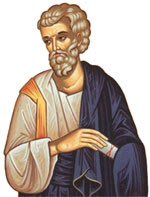
"It is not a question of honor, of privileges, of concessions. The patriarchal institution is a specific entity unique in Eastern ecclesiology. With all respect due to the Petrine ministry, the Patriarchal ministry is equal to it, "servatis servandis", in Eastern ecclesiology. Until this is taken into consideration by the Roman ecclesiology, no progress will be made in ecumenical dialogue. Furthermore, the Patriarchal ministry is not a Roman creation, it is not the fruit of privileges, conceded or granted by Rome."- His Beatitude Gregory III, Patriarch of Antioch for the Greek-Melkites
http://www.vatican.va/news_services/press/sinodo/documents/bollettino_20_x-ordinaria-2001/02_inglese/b10_02.html
Showing posts with label Eastern Catholic. Show all posts
Showing posts with label Eastern Catholic. Show all posts
Monday, November 23, 2009

Friday, January 23, 2009
Proclamation to the faithful of the UGCC on the year of God 2009, the Year of Christian Vocation, with special emphasis on the priestly vocation
Most Reverend and highly honored Clergy
Honored Monks and Nuns,
Dearly beloved in Christ Lay Sisters and Brothers:
God’s blessing and peace in the Lord!
Dearly beloved in Christ!
The main spiritual theme of the past year 2008, according to the decision of the Synod of Bishops of the Ukrainian Greek-Catholic Church of 2007, was Christian vocation. We hope sincerely that during the year which is running to an end we all – clergy or laity, older or younger – indeed were enriched by realizing that everybody who is born in the world in addition to the gift of life and holy faith obtains from the Creator a special task in life, which is a vocation. We hope also that every faithful person tried to recognize more intently his or her own vocation, to cherish and very conscientiously carry it out for the divine glory, for the good of one’s neighbor, and, most importantly, for understanding the meaning of one’s own life. We prayed sincerely for this, singing during the Divine Liturgy in the litany: «Again we pray for all people that they accept with interest the vocation given them by the Lord, that they thank God for it sincerely, and conscientiously and persistently carry it out and serve by it God and people gladly.»
The Synod of Bishops of the Ukrainian Greek-Catholic Church, which took place on September of this year, decreed to continue in the following year, 2009, the theme of Christian vocation with an accent on the priestly vocation, and instead of the above-mentioned petition, to sing in the litany: «Again we pray for our priests, deacons, seminarians, and for their holy vocation.»
In this letter to you, dearly beloved in Christ, I want to explain in more detail this main theme of 2009 A.D. For our pastors and seminarians will be published another, special appeal.
Foremost I want to turn your attention to the fact that in our prayers and reflections we have to continue the theme of Christian vocation in general, and, even more, to try yet deeper, with more detail, to understand it, and most of all to carry it out in our daily life. During 2008 you, probably, listened to sermons, read books, and participated actively in various events on this theme. Such events in particular were organized by eparchies and inter-eparchial commissions, each in the special area (families, youth, laity, and others). Each of us in the future should ask him- or herself how deservingly and pleasing to God they execute the vocation given to him or her and how sincerely they try to help children and youth recognize and carry out their vocations. In addition to this task, the Synod of Bishops calls all of us in 2009 to pay special attention to the priestly vocation. Why? Because for the development and growth of our Church good spiritual leaders are needed, and first of all pastors are accordingly prepared and appointed for this. The bishops invite all members of the Church to consider the sacred character and importance of the priestly vocation and what we, the greater Church community, can do so that our priests be exemplary pastors to God’s glory and for the general good of all the Church and their native nation. We want to offer you a few ideas in relation to this aspect of next year’s spiritual theme.
When we talk about vocation and, in particular, when we call for prayers for priestly vocations, we think usually that our main and unique task is to ask the Lord God to call a sufficient number of candidates to the priestly order or, humanly speaking, to fill our seminaries. Entering the seminary is certainly a very important element, because the realization of the priestly vocation begins with this. However this does not reach the depth of the vocation to the priestly order. First of all, it is necessary to say that study in the seminary is preceded by other stages in this vocation. A good pastor often preaches about vocations and intently looks closely to the members of society, trying to recognize at least its embryo in concrete persons and, if such will notice, to take care to cherish it. A good parish is fruitful soil which bears the beautiful fruits of priestly vocations. One of our parishes in the USA can be an example, in the state of Pennsylvania, which in the 1920s and 1930s gave 37 lasting priestly and monastic vocations. The priests, monks and nuns who came from this community unanimously consider the merit of this in the pastor. A good Christian family, which is like a cradle or hothouse of new spiritual vocations, assists even more in the awakening and growing of a spiritual vocation. In a family of believing people the attitude to the priesthood is honor. Even if an unworthy priest is spoken about, this is said with pain but not with spite. And if there are boys in a family, this vocation is examined as the best possible one.
Not less than the work of father-pastors and the zealous prayer of the Church community, the example of heroes of the faith leads to an awakening of priestly vocations. In connection with this we remember the words of Pope John Paul II of holy memory during the Divine Liturgy in Lviv on June 27, 2001, A.D. Proclaiming 27 members of our Church blessed martyrs, the Holy Father appealed to the priests present at the Liturgy with the words: “If God blesses your land with many vocations and if the seminaries are full – and this is a source of hope for your Church – that is surely one of the fruits of their sacrifice. But it is a great responsibility for you.”
There should be no doubt that the Lord God, as a good Father and Master, calls a sufficient number of workers for the harvest (see Luke 10:2). If there are not enough deserving candidates, however, often we people are guilty, in particular through the decline of spiritual life in our families, through a lack of proper sermons and encouragement, and also through a lack of honor for the priestly status. There is no hope in gaining priestly vocations in families in which the greatest value is money or in which parents’ major care is family relations. It is necessary to remember here the negative influence which the modern mass media has, which quite often becomes the transmitter of anti-Christian ideas and visions. And already quite shattering is the bad life example of some priest, especially the local pastor.
These obstacles are very large, but they are not insuperable. Recently we have more than once heard criticism addressed at priests because of their unworthy conduct or superficial implementation of pastors’ duties. Let us ask ourselves: Did we pray for the correction of such priests, people who fell into a great spiritual crisis? How much did we help them get out of such a tragic state? In fact the priest is not a single island among the wide sea of humanity. He especially needs support from the people who are around him, because he is visible and his every step is well known. Here one should also not underestimate the attacks of the enemy of Church, who operates according to the well-known principle: “I will strike the shepherd, and the sheep of the flock will be dispersed.” (see Zech. 13:7; Mt. 26:31)
Among the means of support which the whole church community should use for its priests, the first place is occupied by prayer. The priest exists and operates with the help of the strength of prayer, not only his own, but also the prayer of the community which he serves. Therefore the Synod of Bishops calls all the members of the Church to pray for priests and deacons – not only for the intention that they be in sufficient quantity, but also first of all that those who enter this holy status in accord with the divine will live out their vocation and fulfill it in a holy way.
Believing people help their priest. For great requirements stand before him: as a person, a pastor, an administrator, a teacher, a citizen, and if he is married – a husband and father. A priest’s life is not covered with a path of roses, except for in those cases when he wants to be a lying prophet and satisfy the whims of the people, instead of leading them to the Heavenly Kingdom. If he tries indeed to be godly, his life is rather a thorny path. Against this background we will understand better who we want to be: the Pharisees who mocked Jesus Christ, or the one from Cyrene who helped Him carry the cross.
Dearly beloved in Christ! We begin 2009, the Year of Christian Vocation with a special accent on the priestly vocation. Let us think about ourselves, about our vocation. Let us reflect on the vocation to the priesthood, because all of us want to see our priests as God’s exemplary servants, the content of whose life is to lead the souls entrusted to them to the Heavenly Father. Together with Jesus Christ, the High Priest, let us pray for and support our priests and deacons.
May the Lord’s blessing be on you!
+ LUBOMYR
Issued in Kyiv, at the Patriarchal Cathedral of the Resurrection of Christ, December 31, 2008
Prayer of the Servant of God Metropolitan Andrey Sheptytsky
for good Ukrainian clergy,
for which we entrust all the faithful of our Church to pray
Lord, O Lord, look down from heaven and visit the vineyard which was planted by Your hand.
May Your all-powerful hand be always on this people which You have loved. Give it, Eternal God, in every generation, until the end of the world, holy bishops and priests, filled with Your Spirit — pastors and teachers of Your law, who would be able unchanging to keep the truth of Your holy incarnation and with love to teach and to lead this great people.
Grant to the Ukrainian clergy the grace to be never afraid of sacrifice, where the only matter is Your glory and the good of this people.
Set on fire in the hearts of Ukrainian priests the spirit of zealousness for the salvation of souls. Open before their eyes the wisdom of Your revelation and give them high feeling for the holiness of those things to which you called them. Bless their work and their intentions. Protect them from every misfortune. And unite them with Your blessings, so that in love they be one – as you, Father with Your Son and the Son with You. Amen.
Former Copic Catholic Patriarch falls asleep in the Lord.
Vatican City/Cairo, 21 January 2009 (KAP/KI) - Egyptian Cardinal and former Coptic Catholic Patriarch (1986-2006) Stéphanos II Ghattas, C.M., died Tuesday January 20, 2009, in Cairo, four days after his 89th birthday. He governed his Church, which is in full communion with Rome, from June 9, 1986, to March 30, 2006. Pope John Paul II (1978-2005) created him a Cardinal in 2001. Following his death the College of Cardinal counts 189 members, of whom 116 are under eighty and have the right to vote in a papal conclave.
Andraos Ghattas was born on January 16, 1920, in Cheikh Zein-el-Dine near Tahta, currently in the Eparchy of Sohag in Egypt. He entered the junior seminary in Cairo in August 1929 and continued his studies at the Jesuit College of the Holy Family, graduating in June 1938. The same year he entered the College of Propaganda Fide in Rome, and in 1944 he earned licenciates in philosophy and theology.
He was ordained Priest on March 25, 1944, in Rome. Han ble presteviet den 25. mars 1944 i Roma. On his return to Egypt, he was appointed Professor of Philosophy and Dogmatic Theology at the Major Seminary of Tahta, then of Tanta. In 1952 he entered the Congregation of the Mission (Lazarists/Vincentians) and completed his noviciate in Paris. After six years of missionary work in Lebanon he was appointed bursar and then superior of the Lazarist community in Alexandria in Egypt.
On May 8, 1967, he was elected Bishop of Thebes-Luxor by the Coptic Catholic Synod. He was ordained Bishop on June 9, 1967, in the Lazarist Church in Alexandria by Cardinal Stéphanos I Sidarouss, C.M., Coptic Catholic Patriarch of Alexandria, and was enthroned in the Cathedral of Tahta on June 16. On February 24, 1984, he was appointed Apostolic Administrator of the Patriarchate during the illness of Patriarch Stéphanos I Sidarouss. Following the resignation of His Beatitude Stéphanos I Sidarouss, the Coptic Catholic Synod convened at the Patriarchal Residence at Koubbeh, and on June 9, 1986, Bishop Andraos Ghattas was unanimously elected the new Patriarch of Alexandria, taking the name of Stephanos II in honour of his predecessor and as a sign of continuity. He received ecclesiastical communion from Pope John Paul II on June 23, 1986. He traveled several times to Canada, Australia and the United States, where he founded the first Coptic Catholic parish.
On February 21, 2001, he was created a Cardinal Bishop by Pope John Paul II. He took part in the funeral of Pope John Paul II on April 8, 2005. On March 30, 2006, at the age of 86, he resigned. The Coptic Catholic Synod of Bishops elected as his successor the current Patriarch Antonios I Naguib.
Source: http://www.katolsk.no/nyheter/2009/01/21-0004.htm
May his memory be eternal!
New Syriac Catholic Patriarch
(Kaldaya) - A few days ago the Synod of the Syriac Catholic Church, that last year failed to elect a new patriarch to replace Mar Ignace Pierre VIII Abdel-Ahad who in January had resigned, after its meeting in Rome came in a short time (3 days) at a decision. The new patriarch of the Syriac Catholic Church is, since yesterday January 20, the bishop of the Diocese of Our Lady of Deliverance for the United States and Canada, Mar Ephrem Joseph Younan who will take the name of Mar Ignatius Joseph III Younan. On Friday 23, the new patriarch will meet the Holy Father, and in mid-February there will be an official ceremony at the patriarchal headquarters in Lebanon.
H.E. Ephrem Joseph Younan
Bishop of Our Lady of Deliverance of Newark, Apostolic Visitator for the Catholic Syriacs in Central America and Venezuela.
H.E. Ephrem Joseph F. Younan born to Farjo & Khatoun (Khabot) Younan on November 15, 1944 in Hassakeh, Syria and baptized on December 8th at Assumption Parish. He is the middle child of nine children, having four brothers and four sisters.
Bishop Joseph Younan attended Assumption Parochial School and after graduation went on to study at Our Lady of Deliverance Seminary in Charfet, Lebanon. He continued to pursue his priestly formation and career at "Propaganda Fide" and earned a double Licentiate (Masters) in philosophy and theology from Urbaniana University in Rome.
Bishop Joseph was ordained to the priesthood on September 12, 1971. After ordination he was appointed as teacher in the Seminary in Charfet where he was director of the major Seminary for two years. He returned to his home Diocese of Hassakeh where he functioned as Diocesan Director of Cathechesis. He remained in this position as director for seven years. He was then appointed pastor of the Church of the Annunciation in Beirut in 1980, where he remained until 1986.
In March of 1986 he was assigned to the United States where he was to establish a mission in the New York/New Jersey Metropolitan area to gather Syriac Rite Catholics. Soon after his arrival, with the guidance and assistance of The Most Reverend Archbishop Theodore E. McCarrick (Archbishop of Newark) he established the first mission of Our Lady of Deliverance. In 1988, he was further appointed by the Sacred Congregation for Eastern Rite Churches as coordinator among his colleague missionary priests in the United States and Canada. And in 1991, he was officially appointed "Apostolic Delegate" by the same Congregation to represent the Congregation and the Syriac Rite to the Catholic hierarchy of North America.
In June of 1991, Father Younan was elevated to the rank of "Corbishop" by the Patriarch, Mar Ignatius Antoun II Hayek. The ceremony took place at Our Lady of Deliverance Mission in Newark, New Jersey.
Since this time, Corbishop Younan traveled from the East Coast to the West Coast (California) on a monthly basis to help establish another mission. Soon after his initial visits, the mission of The Sacred Heart was established in North Hollywood in 1991. Three years after, he reached out again to establish a further mission Church in San Diego called Our Mother of Perpetual Help.
On November 6, 1995, Pope John Paul II appointed him first Bishop (Eparch) of the newly established Diocese (Eparchy) Our Lady of Deliverance Syriac Catholic Diocese for Syriac Catholics in the United States and Canada. He was consecrated Bishop on January 7, 1996 at Saint Peter and Paul's Church in Kamishly, Syria by His Beatitude, the Patriarch Hayek.
Currently, Bishop Younan resides in Union City, New Jersey.
He fluently speaks Arabic, French, Aramaic, Italian, German and English.
http://byztex.blogspot.com/2009/01/syriac-catholic-church-has-new.html
Many years to His Beatitude!
Saturday, November 29, 2008
Mar Thoma Catholics in India ignored by Curia
November 20, 2008
Syro-Malabar Catholics Frustrated With Vatican Offices
NEW DELHI (ICNS): A senior bishop of the Syro-Malabar Church (SMC) says Catholics of his Oriental rite have "lost all faith and hope" of getting justice from Vatican offices.
"Our Church ... (has) patiently waited for justice from the Holy See for the last 42 years, after the Second Vatican Council," Bishop Gregory Karotemprel of Rajkot told a theological seminar in New Delhi, UCA News reported.
The Nov. 14-15 seminar titled "Ecclesial mission of Syro-Malabar Church" addressed various issues including the Church's demand for jurisdiction outside Kerala, the southern Indian state where it is based.
Bishop Karotemprel says his Church has appealed to the Vatican several times for nationwide jurisdiction, especially after it was made sui juris (self governing) 15 years ago.
"But to our great disgust and agony, not even a single line of reply, either positive or negative, was received by the Bishops' Synod," noted the 75-year-old Carmelite of Mary Immaculate prelate, who monitored pastoral care for SMC migrants until a year ago.
The synod, the Church's highest authority, has the power to create dioceses and appoint bishops, in consultation with the pope, but only in Kerala.
The Vatican's silence, Bishop Karotemprel says, creates "an abominable situation" with repercussions such as questioning the credibility of the Holy See.
He accused some Latin-rite bishops of influencing Vatican congregations and the Apostolic Nunciature in New Delhi to block the SMC's "just" right to India-wide jurisdiction.
Bishop Karotemprel says SMC Catholics can no longer tolerate Latin bishops' "ecclesiastical colonization of India" and have "lost all faith and hope" that the Vatican and the nunciature will "ever do justice to their cause." He points out Latin prelates head the important Vatican positions and their people fill other offices in the Vatican congregations.
Nonetheless, he maintains the Vatican alone can find "an equitable and just solution" to the "insoluble disputes" between India's Latin and SMC Churches.
The SMC prelate says his people also wonder whether the Vatican's "culpable silence" requires "another law to implement what is right and just."
In his analysis, "a negative written reply" from the Vatican would negate its own teachings, while a positive reply would "invite very strong opposition" from the Latin Church. Such "games" need "a final whistle," he added.
Bishop Karotemprel regrets the Vatican's new demand that two-thirds of Latin-rite bishops in India should agree to grant SMC nationwide jurisdiction. Since most Latin prelates oppose the demand, the Vatican stand amounts to "absurd" ecclesiastical jurisprudence, he explained.
The SMC prelate remarked that the Church champions truth and justice but "totally denies" those values in "its internal administration."
SMC migrants in Latin dioceses know their just and juridical rights, and "are totally fed up" with the Vatican attitude, Bishop Karotemprel stated.
However, in concluding he recalled that his 2,000-year-old Church "never got separated from the See of Peter" and pledged "filial love and obedience to our Holy Father Pope Benedict XVI."
Describing the pope as the "ultimate dispenser of truth and justice in the Church," he urged SMC Catholics to remain "hopeful."
The Latin rite accounts for 128 of India's 160 dioceses. The SMC has 26 dioceses in India, including 10 outside Kerala, to which 3.5 million of India's 17 million Catholics belong. It also has one diocese for North America, based in Chicago, the United States.
Latin rite follows the Roman liturgy introduced by European missioners in the 15th century.
The SMC is the larger of the two Oriental-rite Churches in India, both of which follow Syrian Church traditions and trace their origins to Saint Thomas the Apostle. The smaller Syro-Malankara Church, also based in Kerala, has six dioceses.
Until the Second Vatican Council (1962-65), India's Oriental-rite Churches were confined to Kerala. The council set up SMC dioceses outside Kerala, but placed them in ecclesiastical provinces headed by Latin-rite archdioceses.
The Vatican made the SMC self-governing in 1992 but retained the right to decide on administrative matters for its dioceses outside Kerala.
Translation, we like Eastern Catholicism in India as long as it doesn't threaten the latin tradition brought inby the colonial days.
Saturday, November 15, 2008
Update
Hi
I haven't been on in ahwile to update this thing but I have not abandoned it. I will be back on here soon enough to post stuff of some kind. In other news, my transfer to the Ukrainian church is complete : ) so it is official now .
-edited, sorry typo.
I haven't been on in ahwile to update this thing but I have not abandoned it. I will be back on here soon enough to post stuff of some kind. In other news, my transfer to the Ukrainian church is complete : ) so it is official now .
-edited, sorry typo.
Wednesday, October 1, 2008
Some Monarchist Akathist hymns
http://www.angelfire.com/planet/parastos/akathistdavid.html
Akathist hymn to Saint David, King of Israel
http://www.angelfire.com/planet/parastos/akathisttsar.html
Akathist to Saint Nicholas , Tsar and Passionbearer
http://www.angelfire.com/planet/parastos/akathiststelizabeth.html
Akathist to Saint Elizabeth, Grand Duchess and Passionbearer
The sites don't include the introduction prayers. But a quick search on the net for Akathist hymn will provide one with the proper introduction prayers.
In other news, I am about to send my letter off to Bishop Jugis and Bishop Robert for canonical transfer. Just waiting for my sacramental documents to arrive by mail so I can send em off.
Sunday, September 14, 2008
Exaltation of the Holy Cross
Kontakion Tone 1
AS you were voluntarily raised upon the cross for our sake, Grant mercy to those who are called by Your Name, O Chris God; Make all Orthodox Christians glad by Your power, Granting them victories over their adversaries, by bestowing on them the invincible trophy, Your weapon of Peace.
AS you were voluntarily raised upon the cross for our sake, Grant mercy to those who are called by Your Name, O Chris God; Make all Orthodox Christians glad by Your power, Granting them victories over their adversaries, by bestowing on them the invincible trophy, Your weapon of Peace.
Sunday, March 30, 2008
Chaldean Catholic Pascha Qurbona
mms://wmedia2.propagation.net/kaldu/Easter_08/easter_mass_wmv.asf
This is a video of the Chaldean Qurbona. The Chaldeans belong to the East Syriac tradition so there will are similarities , but also many differences between them and the Maronites. Its a pretty interesting liturgy. Sadly I can tell it has latinizations and modernizations to deal with : ( .
This is a video of the Chaldean Qurbona. The Chaldeans belong to the East Syriac tradition so there will are similarities , but also many differences between them and the Maronites. Its a pretty interesting liturgy. Sadly I can tell it has latinizations and modernizations to deal with : ( .
Monday, March 3, 2008
Maronites
Since January, I have come to a startling conclusion. When I think theologically, I am thinking from an Eastern basis for some of my views. I realized that the emptiness of the Novus Ordo Mass was not just the NO, but the Tridentine Mass as well. I do not beleive I am a latin anymore theologically or liturgically. I am some kind of stange hybred between the two. So I decided I will rediscern Eastern Catholicism once again. Now I fully understand the implications of the Filioque so I have no reason to worry of being led astray by photian schismatics. At first I thought the Byzantine Liturgy at St. Basil's was where I should go. It is better there, but it is not home. I realized two sundays ago that the Maronites were where I felt most comfortable. This is not really new information, I had realized this over Christmas break as well when I would go there instead of my Latin Catholic parish. I had stopped attending the Maronite Qurbono at St. Elias' as much over last summer break because I thought I should reaquaint myself with St. Andrew's since I had avoided it for so long due to my SSPX schismatic mindset. Now that I am fully recovered from this SSPX mindset, I realize that the Maronite Church had grown on me immensely. What is the point of this blog post one may ask? Well I beleive that this is the start of a serious discernment as to whether I should become a maronite or remain a latin Catholic. I am not doing this to be a married priest. Especially since in the Maronite church, a married priest's ordination is pushed much further back then an unmarried cleric. No my motivation here is a serious look at whether or not I am indeed a Latin Catholic at heart, or a Maronite Catholic. This even makes my priestly, and religious discernment harder because you must wait five years after switching Ritual Churches to enter seminary in it. At best I am looking at 26 before I could even consider entering a seminary if that is what God is calling me to. Even then, Maronite priests must learn Arabic on top of Syriac.
And then, what am I to do if I feel called to serve as a Holy Land Franciscan or a Benedictine at BAC? Would I be forced to abandon the Liturgy of my potential Church? If thats the case then would I not be better just remaining a latin? So many questions and I do not really have a maronite pastor to even ask these questions to! Abuna Bart is a nice guy, but I barely know him, and Abuna Claude I do not know either. Abuna Rudolph is off in Pittsburgh now and perhaps does not even remeber who exactly I was. There is no easy access to the maronite vocations director, excluding phone or letters. I just need to trust that God will not lead me astray and that in the end, whatever I discern, that it will be His will guiding my safetly.
And then, what am I to do if I feel called to serve as a Holy Land Franciscan or a Benedictine at BAC? Would I be forced to abandon the Liturgy of my potential Church? If thats the case then would I not be better just remaining a latin? So many questions and I do not really have a maronite pastor to even ask these questions to! Abuna Bart is a nice guy, but I barely know him, and Abuna Claude I do not know either. Abuna Rudolph is off in Pittsburgh now and perhaps does not even remeber who exactly I was. There is no easy access to the maronite vocations director, excluding phone or letters. I just need to trust that God will not lead me astray and that in the end, whatever I discern, that it will be His will guiding my safetly.
Subscribe to:
Posts (Atom)
Blessed Constantine XI

Mar Isaac of Syria

St. Gregory Palamas