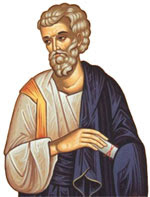
I think I am going to attempt to compile a list of those saints that were monarchs of their countries
Pre-Christian
King David
Latin Catholic
Bl. Charlemagne
Bl. Karl I of Austria
St. Louis of France
St. Edward the Confessor
Byzantine (Catholic and Orthodox)
St. Justinian
St. Theodosios
Great King, St. Constantine
Great King, St. Voldomyr and his mother Olha of Kyiv
Bl. Constantine XI
St. Nicholas, last Tsar and Passion-bearer
Protestant Churches (Anglican)
Charles I Stuart, King of England, Scotland, France, etc.
More to come, the list will be updated each time I think of more.If ye know any (like Armenians, Ethiopians, etc) that I missed then leaving a comment would be great. Plus there are many kyivan princes in the Ukrainian calender that I have missed that will require some time to go through and get them all. A fact I always find interesting is that St. Nicholas of Russia and Bl. Karl of Austria were both the last two sovereigns of empires that claimed succession from the Roman Empire, and both fought on opposing sides in WWI.
Showing posts with label Monarchy. Show all posts
Showing posts with label Monarchy. Show all posts
Monday, March 23, 2009

Tuesday, January 20, 2009
Double post!
Sorry I didn't get around to this yesterday, but I wanted to commemorate St. Mark of Ephesus , whose feast was yesterday.
"
Kontakion in the Third Tone
Clad, O godly-minded one, with an invincible armor, thou didst dash to pieces the pride of the Western rebellion; thou wast brought forth as the champion of Orthodoxy, as the Comforter's own instrument and pure vessel. For this cause, to thee we cry out: Rejoice, O Mark, thou boast of the Orthodox flock.
"
"We seek and we pray for our return to that time when, being united, we spoke the same things and there was no schism between us." - St.Mark of Ephesus.
St. Mark was the only Orthodox Bishop who did not sign the decrees of Florence and most likely because he realized that it was not a true reunion, but a false one. Nothing was resolved and when he refused to sign the Pope himself cried out that nothing had been resolved (not exact quote). Today we Byzantine Catholics pave the path for eventual reunion between the two sides and perhaps St. Mark would not be the most pleased at our own situation during his life, but our union is different then that of Florence.

Also, I would like to remember the trial of King Charles I of England and Scotland. A king whom was betrayed by his own people. May his memory be eternal!
"
Kontakion in the Third Tone
Clad, O godly-minded one, with an invincible armor, thou didst dash to pieces the pride of the Western rebellion; thou wast brought forth as the champion of Orthodoxy, as the Comforter's own instrument and pure vessel. For this cause, to thee we cry out: Rejoice, O Mark, thou boast of the Orthodox flock.
"
"We seek and we pray for our return to that time when, being united, we spoke the same things and there was no schism between us." - St.Mark of Ephesus.
St. Mark was the only Orthodox Bishop who did not sign the decrees of Florence and most likely because he realized that it was not a true reunion, but a false one. Nothing was resolved and when he refused to sign the Pope himself cried out that nothing had been resolved (not exact quote). Today we Byzantine Catholics pave the path for eventual reunion between the two sides and perhaps St. Mark would not be the most pleased at our own situation during his life, but our union is different then that of Florence.

Also, I would like to remember the trial of King Charles I of England and Scotland. A king whom was betrayed by his own people. May his memory be eternal!
Friday, December 26, 2008
Christmas message of Her Royal Majesty Queen Elizabeth II
"Christmas is a time for celebration, but this year it is a more sombre occasion for many. Some of those things which could once have been taken for granted suddenly seem less certain and, naturally, give rise to feelings of insecurity.
"People are touched by events which have their roots far across the world. Whether it is the global economy or violence in a distant land, the effects can be keenly felt at home.
"Once again, many of our service men and women are serving on operations in common cause to bring peace and security to troubled places.
"In this 90th year since the end of the First World War, the last survivors recently commemorated the service and enormous sacrifice of their own generation.
"Their successors in theatres such as Iraq and Afghanistan are still to be found in harm's way in the service of others. For their loved ones, the worry will never cease until they are safely home.
"In such times as these we can all learn something from the past. We might begin to see things in a new perspective. And certainly, we begin to ask ourselves where it is that we can find lasting happiness.
"Over the years those who have seemed to me to be the most happy, contented and fulfilled have always been the people who have lived the most outgoing and unselfish lives; the kind of people who are generous with their talents or their time.
"There are those who use their prosperity or good fortune for the benefit of others whether they number among the great philanthropists or are people who, with whatever they have, simply have a desire to help those less fortunate than themselves.
"What they offer comes in the form of what can easily be recognised as service to the nation or service to the wider community.
"As often as not however, their unselfishness is a simply taken-for-granted part of the life of their family or neighbourhood.
"They tend to have some sense that life itself is full of blessings, and is a precious gift for which we should be thankful.
"When life seems hard the courageous do not lie down and accept defeat; instead they are all the more determined to struggle for a better future.
"I think we have a huge amount to learn from individuals such as these. And what I believe many of us share with them is a source of strength and peace of mind in our families and friends.
"Indeed, Prince Philip and I can reflect on the blessing, comfort and support we have gained from our own family in this special year for our son, the Prince of Wales. Sixty years ago, he was baptised here in the Music Room at Buckingham Palace. As parents and grandparents, we feel great pride in seeing our family make their own unique contributions to society.
"Through his charities, the Prince of Wales has worked to support young people and other causes for the benefit of the wider community.
"At Christmas, we feel very fortunate to have our family around us. But for many of you, this Christmas will mean separation from loved ones and perhaps reflection on the memories of those no longer with us.
"I hope that, like me, you will be comforted by the example of Jesus of Nazareth who, often in circumstances of great adversity, managed to live an outgoing, unselfish and sacrificial life. Countless millions of people around the world continue to celebrate his birthday at Christmas, inspired by his teaching.
"He makes it clear that genuine human happiness and satisfaction lie more in giving than receiving; more in serving than in being served.
"We can surely be grateful that, two thousand years after the birth of Jesus, so many of us are able to draw inspiration from his life and message, and to find in him a source of strength and courage.
"I hope that the Christmas message will encourage and sustain you too, now and in the coming year.
"I wish you all a very happy Christmas."
God save the Queen
"People are touched by events which have their roots far across the world. Whether it is the global economy or violence in a distant land, the effects can be keenly felt at home.
"Once again, many of our service men and women are serving on operations in common cause to bring peace and security to troubled places.
"In this 90th year since the end of the First World War, the last survivors recently commemorated the service and enormous sacrifice of their own generation.
"Their successors in theatres such as Iraq and Afghanistan are still to be found in harm's way in the service of others. For their loved ones, the worry will never cease until they are safely home.
"In such times as these we can all learn something from the past. We might begin to see things in a new perspective. And certainly, we begin to ask ourselves where it is that we can find lasting happiness.
"Over the years those who have seemed to me to be the most happy, contented and fulfilled have always been the people who have lived the most outgoing and unselfish lives; the kind of people who are generous with their talents or their time.
"There are those who use their prosperity or good fortune for the benefit of others whether they number among the great philanthropists or are people who, with whatever they have, simply have a desire to help those less fortunate than themselves.
"What they offer comes in the form of what can easily be recognised as service to the nation or service to the wider community.
"As often as not however, their unselfishness is a simply taken-for-granted part of the life of their family or neighbourhood.
"They tend to have some sense that life itself is full of blessings, and is a precious gift for which we should be thankful.
"When life seems hard the courageous do not lie down and accept defeat; instead they are all the more determined to struggle for a better future.
"I think we have a huge amount to learn from individuals such as these. And what I believe many of us share with them is a source of strength and peace of mind in our families and friends.
"Indeed, Prince Philip and I can reflect on the blessing, comfort and support we have gained from our own family in this special year for our son, the Prince of Wales. Sixty years ago, he was baptised here in the Music Room at Buckingham Palace. As parents and grandparents, we feel great pride in seeing our family make their own unique contributions to society.
"Through his charities, the Prince of Wales has worked to support young people and other causes for the benefit of the wider community.
"At Christmas, we feel very fortunate to have our family around us. But for many of you, this Christmas will mean separation from loved ones and perhaps reflection on the memories of those no longer with us.
"I hope that, like me, you will be comforted by the example of Jesus of Nazareth who, often in circumstances of great adversity, managed to live an outgoing, unselfish and sacrificial life. Countless millions of people around the world continue to celebrate his birthday at Christmas, inspired by his teaching.
"He makes it clear that genuine human happiness and satisfaction lie more in giving than receiving; more in serving than in being served.
"We can surely be grateful that, two thousand years after the birth of Jesus, so many of us are able to draw inspiration from his life and message, and to find in him a source of strength and courage.
"I hope that the Christmas message will encourage and sustain you too, now and in the coming year.
"I wish you all a very happy Christmas."
God save the Queen
Sunday, November 2, 2008
Voting
With the election comming up, I felt I needed to comment on it.
I have noticed this from many of my peers and others, that there is an attitude that we must vote for the "lesser of two evils" and that not voting is the equivalent of giving the election to the greater evil. I contend that voting is neither necessary and that voting for the lesser of two evils is unacceptable.
For my first point, voting in general. How can something that has, until recent times, been unavalible to the people be a requirement? Even in the United States, only property owning men could initially vote. They clearly did not see as necessary for everyone to vote. From a Catholic point of view, the Church has constantly throughout her history been supportive of Monarchies where voting for the leader of the nation was out of the question (or if it was voting, it was like the Holy Roman Empire or the Papacy itself, done by the nobility or cardinals). So how can it be necessary to vote?
Next the lesser of two evils arguement. What exactly makes the lesser evil a good idea to vote for? Just because he is supposedly pro life (you know not including his support of EMBYRONIC stem cells, and unjust war)? No, because McCain can't change anything once he is elected, at best he can keep the status quo, at worst he can nominate a new judge that will be a hidden pro infanticide justice. There are plenty of third party choices (that btw if the 40% of the population that is Catholic voted for ) could be viable candidates if given support.
This leads to my next point, if we beleive in Objective moral values, then how can we even possibly dream of supporting something like a neo-republic/representitve democracy. Where truth is put to a vote and whoever is in the majority can impose their will upon everyone else. Rather then the potential tyranny of one man, we are given the tyranny of the majority. Its not much different, except that a monarchy at least recognizes that its power comes from God so even if he is a bad monarch, he is still going have this ingrained into his person if he has been raised from birth for the position. The people ,on the contrary, change their flavor of the month. Every four or eight years we change our minds. Monarchy, on the contrary is a stable regime that conserves the state and nurtures it so that it can organically develop. It prides itself on its traditions and values and looks towards its God-given ruler for guidance and stability. In these unstable times one would think that we would desire this in our country. Rather we instead are after "change", whatever that means. I can tell you what I beleive it means, and I beleive it means that we want to further weaken our standing in the world. That we want to further degenerate as a society, and that we would rather elect corrupt politicians who waste our money rather then look into the future and realize that the America everyone talks about, hasn't existed for a long time now.
As for me, I do not beleive I will vote. There is no candidate on the ballot in this state that I could even hold my nose and support. Perhaps I could move to Louisiana and vote for Ron Paul (whom is the candiate for the Louisiana tax payers party or something, probably without his consent).
I have noticed this from many of my peers and others, that there is an attitude that we must vote for the "lesser of two evils" and that not voting is the equivalent of giving the election to the greater evil. I contend that voting is neither necessary and that voting for the lesser of two evils is unacceptable.
For my first point, voting in general. How can something that has, until recent times, been unavalible to the people be a requirement? Even in the United States, only property owning men could initially vote. They clearly did not see as necessary for everyone to vote. From a Catholic point of view, the Church has constantly throughout her history been supportive of Monarchies where voting for the leader of the nation was out of the question (or if it was voting, it was like the Holy Roman Empire or the Papacy itself, done by the nobility or cardinals). So how can it be necessary to vote?
Next the lesser of two evils arguement. What exactly makes the lesser evil a good idea to vote for? Just because he is supposedly pro life (you know not including his support of EMBYRONIC stem cells, and unjust war)? No, because McCain can't change anything once he is elected, at best he can keep the status quo, at worst he can nominate a new judge that will be a hidden pro infanticide justice. There are plenty of third party choices (that btw if the 40% of the population that is Catholic voted for ) could be viable candidates if given support.
This leads to my next point, if we beleive in Objective moral values, then how can we even possibly dream of supporting something like a neo-republic/representitve democracy. Where truth is put to a vote and whoever is in the majority can impose their will upon everyone else. Rather then the potential tyranny of one man, we are given the tyranny of the majority. Its not much different, except that a monarchy at least recognizes that its power comes from God so even if he is a bad monarch, he is still going have this ingrained into his person if he has been raised from birth for the position. The people ,on the contrary, change their flavor of the month. Every four or eight years we change our minds. Monarchy, on the contrary is a stable regime that conserves the state and nurtures it so that it can organically develop. It prides itself on its traditions and values and looks towards its God-given ruler for guidance and stability. In these unstable times one would think that we would desire this in our country. Rather we instead are after "change", whatever that means. I can tell you what I beleive it means, and I beleive it means that we want to further weaken our standing in the world. That we want to further degenerate as a society, and that we would rather elect corrupt politicians who waste our money rather then look into the future and realize that the America everyone talks about, hasn't existed for a long time now.
As for me, I do not beleive I will vote. There is no candidate on the ballot in this state that I could even hold my nose and support. Perhaps I could move to Louisiana and vote for Ron Paul (whom is the candiate for the Louisiana tax payers party or something, probably without his consent).
Monday, October 20, 2008
A Novena for the Canonization of Blessed Charles
Prayer for the Canonization of Blessed Emperor Karl of Austria:
[To be prayed at the beginning of each day of the novena.]
Heavenly Father, through Blessed Emperor Karl You have given Your Church and the people of God an example of how we can live a discerning and spiritual life in a convincing and courageous way.
His public actions as emperor and king, and his personal acts as a family man, were firmly based in the teachings of the Catholic Faith. His love for his Eucharistic Lord grew in times of trial, and helped him to unite himself to Christ’s sacrifice through his own life’s sacrifice for his peoples. Emperor Karl honored the Mother of God, and loved to pray the rosary throughout his life.
Strengthen us by his intercession when discouragement, faintheartedness, loneliness, bitterness and depression trouble us. Let us follow the example of Your faithful servant, and unselfishly serve our brothers and sisters according to Your will.
Hear my petitions and grant my request [mention your intention here].
Grant that Blessed Karl of Austria be deemed worthy of canonization, for the glory of Your Name, the praise of the Blessed Virgin Mary, and for blessings upon the Church.
Amen.
Day One:
Reverence for the Most Blessed Sacrament
Blessed Karl lived under the glory of the Blessed Sacrament. The rays of grace from this splendor attracted him, and he loved to visit the tabernacle. Whether stressed by the strains of government or just the ordinary beginning of his day, he sought guidance and solace before Jesus Christ in the tabernacle. Wherever he lived, he sought to have a private chapel where the Blessed Sacrament could be reserved. His devotion to the Eucharist manifested itself even in small details, such as his concern that the sanctuary lamp should never be allowed to go out. Several times a day he would say: “I must go to see if the altar light is still burning.” When he said this, everyone knew that he would be away for some time kneeling and praying before the Blessed Sacrament.
The depths of his prayer and meditation were so great that he was often unaware of what was occurring around him. For instance, he frequently was so caught up in prayer that he did not realize that the collection basket was being passed. In order not to disturb him, Empress Zita talked him into holding his offering in his hand from the beginning of Mass so that she could nudge his arm to drop the money into the basket at the appropriate time.
Father Maurus Carnot, O.S.B., said about Emperor Karl: “In Disentis [Switzerland], it did not matter whether it was snowing or if there were snow drifts, he was always punctual for Holy Mass at the Church of Saint Mary, where he would receive Holy Communion during the masses that Crown Prince Otto, with his boyish curly hair, would serve...”
During the Emperor’s fatal illness, he had the strongest longings to frequently receive Holy Communion. Holy Mass was regularly celebrated in the drawing room adjacent to his sick room. At first the door was left ajar so that he could follow the masses without losing privacy or risk infecting others, but he soon requested that the door be left wide open saying: “I do so want to see the altar!” He was so respectful of the Eucharist that he was not going to receive because he was afraid that his constant coughing might profane the host, but remarkably, during the holy rites his coughing stopped completely and he was able to take Communion. It was as if he were compelled by the Lord to receive Holy Communion. When he asked the Empress to tell the priest that he wished to receive Communion, she told him that it was not possible because Countess Mensdorff was going to receive the only host consecrated. Emperor Karl could not be dissuaded, so Empress Zita went to the priest and saw that he too must have had an inner voice because he had consecrated an additional host for the Emperor.
As Emperor Karl lived, so did he die. In life he was united with our Eucharistic Lord, and the Blessed Sacrament was the center of his life when he died. Half an hour before he died he wished to receive Holy Communion. Although his face was pale and drawn from his long, tiring struggle with illness, his face radiated with joy as he received the Eucharist. This radiance remained on his face after his death. During the Emperor’s final moments, Father Zsámboki held the Blessed Sacrament before his eyes, and in the presence of the Eucharist he said his final words: “Thy Will be done, Jesus, Jesus, come!” With his final breath, he whispered: “Jesus!”
He now entered that eternal light, which is symbolized by the sanctuary lamp he had so carefully attended in his chapel.
Prayer:
My Lord and God, according to the marvelous example of Your servant, Emperor Karl, I will visit You in the tabernacle frequently, and receive You with joy and longing in the most Blessed Sacrament of the Eucharist. Hear my petitions and grant my request [mention your intention here] through the intercession of Blessed Emperor Karl of Austria. Amen
[Hail Mary. Our Father. Glory Be.]
Concluding Prayer
[To be prayed at the conclusion of each day of the novena.]
God our Father, through the gift of Blessed Emperor Karl You have given us an example to follow.
In extremely difficult times he performed his burdensome tasks without ever losing his faith.
He always followed Your Son, the true King.
He led a humble life, sincerely loving the poor and giving himself heart and soul to the search for peace. Even when his life was in danger he trusted in You, putting his life in Your hands.
Almighty and Merciful God, by the intercession of Blessed Emperor Karl, we pray that You may give us his unconditional faith to support us in our most difficult situations, and the courage to always follow the example of Your only Son.
Open our hearts to the poor, and strengthen our commitment for peace within our families and among all peoples.
We ask this through Christ our Lord.
Amen.
I will post the next novena prayer everyday. This is for October 21. If you read this please consider praying this.
[To be prayed at the beginning of each day of the novena.]
Heavenly Father, through Blessed Emperor Karl You have given Your Church and the people of God an example of how we can live a discerning and spiritual life in a convincing and courageous way.
His public actions as emperor and king, and his personal acts as a family man, were firmly based in the teachings of the Catholic Faith. His love for his Eucharistic Lord grew in times of trial, and helped him to unite himself to Christ’s sacrifice through his own life’s sacrifice for his peoples. Emperor Karl honored the Mother of God, and loved to pray the rosary throughout his life.
Strengthen us by his intercession when discouragement, faintheartedness, loneliness, bitterness and depression trouble us. Let us follow the example of Your faithful servant, and unselfishly serve our brothers and sisters according to Your will.
Hear my petitions and grant my request [mention your intention here].
Grant that Blessed Karl of Austria be deemed worthy of canonization, for the glory of Your Name, the praise of the Blessed Virgin Mary, and for blessings upon the Church.
Amen.
Day One:
Reverence for the Most Blessed Sacrament
Blessed Karl lived under the glory of the Blessed Sacrament. The rays of grace from this splendor attracted him, and he loved to visit the tabernacle. Whether stressed by the strains of government or just the ordinary beginning of his day, he sought guidance and solace before Jesus Christ in the tabernacle. Wherever he lived, he sought to have a private chapel where the Blessed Sacrament could be reserved. His devotion to the Eucharist manifested itself even in small details, such as his concern that the sanctuary lamp should never be allowed to go out. Several times a day he would say: “I must go to see if the altar light is still burning.” When he said this, everyone knew that he would be away for some time kneeling and praying before the Blessed Sacrament.
The depths of his prayer and meditation were so great that he was often unaware of what was occurring around him. For instance, he frequently was so caught up in prayer that he did not realize that the collection basket was being passed. In order not to disturb him, Empress Zita talked him into holding his offering in his hand from the beginning of Mass so that she could nudge his arm to drop the money into the basket at the appropriate time.
Father Maurus Carnot, O.S.B., said about Emperor Karl: “In Disentis [Switzerland], it did not matter whether it was snowing or if there were snow drifts, he was always punctual for Holy Mass at the Church of Saint Mary, where he would receive Holy Communion during the masses that Crown Prince Otto, with his boyish curly hair, would serve...”
During the Emperor’s fatal illness, he had the strongest longings to frequently receive Holy Communion. Holy Mass was regularly celebrated in the drawing room adjacent to his sick room. At first the door was left ajar so that he could follow the masses without losing privacy or risk infecting others, but he soon requested that the door be left wide open saying: “I do so want to see the altar!” He was so respectful of the Eucharist that he was not going to receive because he was afraid that his constant coughing might profane the host, but remarkably, during the holy rites his coughing stopped completely and he was able to take Communion. It was as if he were compelled by the Lord to receive Holy Communion. When he asked the Empress to tell the priest that he wished to receive Communion, she told him that it was not possible because Countess Mensdorff was going to receive the only host consecrated. Emperor Karl could not be dissuaded, so Empress Zita went to the priest and saw that he too must have had an inner voice because he had consecrated an additional host for the Emperor.
As Emperor Karl lived, so did he die. In life he was united with our Eucharistic Lord, and the Blessed Sacrament was the center of his life when he died. Half an hour before he died he wished to receive Holy Communion. Although his face was pale and drawn from his long, tiring struggle with illness, his face radiated with joy as he received the Eucharist. This radiance remained on his face after his death. During the Emperor’s final moments, Father Zsámboki held the Blessed Sacrament before his eyes, and in the presence of the Eucharist he said his final words: “Thy Will be done, Jesus, Jesus, come!” With his final breath, he whispered: “Jesus!”
He now entered that eternal light, which is symbolized by the sanctuary lamp he had so carefully attended in his chapel.
Prayer:
My Lord and God, according to the marvelous example of Your servant, Emperor Karl, I will visit You in the tabernacle frequently, and receive You with joy and longing in the most Blessed Sacrament of the Eucharist. Hear my petitions and grant my request [mention your intention here] through the intercession of Blessed Emperor Karl of Austria. Amen
[Hail Mary. Our Father. Glory Be.]
Concluding Prayer
[To be prayed at the conclusion of each day of the novena.]
God our Father, through the gift of Blessed Emperor Karl You have given us an example to follow.
In extremely difficult times he performed his burdensome tasks without ever losing his faith.
He always followed Your Son, the true King.
He led a humble life, sincerely loving the poor and giving himself heart and soul to the search for peace. Even when his life was in danger he trusted in You, putting his life in Your hands.
Almighty and Merciful God, by the intercession of Blessed Emperor Karl, we pray that You may give us his unconditional faith to support us in our most difficult situations, and the courage to always follow the example of Your only Son.
Open our hearts to the poor, and strengthen our commitment for peace within our families and among all peoples.
We ask this through Christ our Lord.
Amen.
I will post the next novena prayer everyday. This is for October 21. If you read this please consider praying this.
Blessed Emperor Charles

"The decisive task of Christians consists in seeking, recognizing and following God's will in all things. The Christian statesman, Charles of Austria , confronted this challenge every day. To his eyes, war appeared as "something appalling". Amid the tumult of the First World War, he strove to promote the peace initiative of my Predecessor, Benedict XV.
From the beginning, the Emperor Charles conceived of his office as a holy service to his people. His chief concern was to follow the Christian vocation to holiness also in his political actions. For this reason, his thoughts turned to social assistance. May he be an example for all of us, especially for those who have political responsibilities in Europe today!" - John Paul II
God our Father, through the gift of Blessed Emperor Karl You have given us an example to follow. In extremely difficult times he performed his burdensome tasks without ever losing his faith. He always followed Your Son, the true King.
He led a humble life, sincerely loving the poor and giving himself heart and soul to the search for peace. Even when his life was in danger he trusted in You, putting his life in Your hands. Almighty and Merciful God, by the intercession of Blessed Emperor Karl, we pray that You may give us his unconditional faith to support us in our most difficult situations, and the courage to always follow the example of Your only Son.
Open our hearts to the poor, and strengthen our commitment for peace within our families and among all peoples.
We ask this through Christ our Lord.
O Blessed Emperor Karl, you accepted the difficult tasks and burdensome challenges that God gave you during your life. In every thought, decision and action you trusted always in the Holy Trinity. We pray to you to intercede for us with the Lord our God to give us faith and courage, so that even in the most difficult situations of our earthly lives we may not lose heart, but continue faithfully in the footsteps of Christ.
Ask for us the grace that our hearts may be moulded into the likeness of the Sacred Heart of Jesus. Help us to work with compassion and strength for the poor and needy, to fight with courage for peace in our homes and in the world, and in every situation to trustingly place our lives in the hands of God, until we reach Him, as you did, through Christ our Lord.
Tuesday, October 14, 2008
A series of a series of youtubes
Father Serge Keleher celebrating Divine Liturgy in Singapore, if you listen closely you can catch which monarch he comemorates during the prayers ; p
Friday, October 3, 2008
Music

So lately I have been listening to this one song called "Farewell of Slavianka" , since its recorded by the Red Army Choir I figured it was a soviet song. It was just so catchy though I couldn't help but enjoy it, even if those bloody reds wrote it. BUT to my pleasent surprise this song is actually from 1912 and was a military march for Imperial Russia and later the White Army. So now I love the song even more. Please excuse me for using this soviet propoganda youtube video for the song, but the Red Army recording is very high quality. http://www.youtube.com/watch?v=_0OkQpYYCDs
Farewell of a Slavic Woman
Arise, Russian Land, defend your Faith!
We have composed many a song in our heart,
Glorifying the native fields.
We've loved you no matter what,
You, our holy Russian land.
You've raised your head high,
You face has been shining like the sun.
You've become a victim of betrayal --
by those who have cheated and sold you!
Refrain:
Again, march ahead!
Again, the bugle calls!
Again, we'll join the ranks
And all march into the holy battle.
Arise, Russian Land, defend the faith!
Russia's holiness awaits victory.
Respond, the Orthodox host!
Where is your Ilya Muromets,
Where is Dobrynia?
The mother is summoning her sons.
Refrain
We all are children of a Great Power,
We all remember the forefathers' commandment:
For the sake of the Flag, Honor, Glory,
Pity neither yourself not the foe.
Arise, Russia, from your prison of slavery,
Victory's spirit is calls: time to do battle!
Rise your battle flags
For Truth, Beauty, and Good.
Also, if anyone has any good resources on learning how to read the Ukrainian alphabet and pronouce it then please provide them : p
Wednesday, October 1, 2008
Some Monarchist Akathist hymns
http://www.angelfire.com/planet/parastos/akathistdavid.html
Akathist hymn to Saint David, King of Israel
http://www.angelfire.com/planet/parastos/akathisttsar.html
Akathist to Saint Nicholas , Tsar and Passionbearer
http://www.angelfire.com/planet/parastos/akathiststelizabeth.html
Akathist to Saint Elizabeth, Grand Duchess and Passionbearer
The sites don't include the introduction prayers. But a quick search on the net for Akathist hymn will provide one with the proper introduction prayers.
In other news, I am about to send my letter off to Bishop Jugis and Bishop Robert for canonical transfer. Just waiting for my sacramental documents to arrive by mail so I can send em off.
Akathist hymn to Saint David, King of Israel
http://www.angelfire.com/planet/parastos/akathisttsar.html
Akathist to Saint Nicholas , Tsar and Passionbearer
http://www.angelfire.com/planet/parastos/akathiststelizabeth.html
Akathist to Saint Elizabeth, Grand Duchess and Passionbearer
The sites don't include the introduction prayers. But a quick search on the net for Akathist hymn will provide one with the proper introduction prayers.
In other news, I am about to send my letter off to Bishop Jugis and Bishop Robert for canonical transfer. Just waiting for my sacramental documents to arrive by mail so I can send em off.
Wednesday, September 24, 2008
INTRODUCTION TO THE JESUS PRAYER
by H.R.H. Princess Ileana of Romania
"
Lord Jesus Christ, Son of God, have mercy upon me, a sinner.
I have often read the Jesus Prayer in prayer books and heard it in church, but my attention was drawn to it first some years ago in Romania. There in a small Monastery of Sâmbata, tucked away at the foot of the Carpathians in the heart of the deep forest, its little white church reflected in a crystal-clear mountain pond, I met a monk who practiced the "prayer of the heart". Profound peace and silence reigned at Sâmbata in those days; it was a place of rest and strength—I pray God it still is.
I have wandered far since I last saw Sâmbata, and all the while the Jesus Prayer lay as a precious gift buried in my heart. It remained inactive until a few years ago, when I read The Way of a Pilgrim. Since then I have been seeking to practice it continually. At times I lapse; nonetheless, the prayer has opened unbelievable vistas within my heart and soul.
The Jesus Prayer, or the Prayer of the Heart, centers on the Holy Name itself. It may be said in its entirety: "Lord Jesus Christ, Son of God, have mercy upon me, a sinner;" it may be changed to "us sinners" or to other persons named, or it may be shortened. The power lies in the name of Jesus; thus "Jesus," alone, may fulfill the whole need of the one who prays.
The Prayer goes back to the New Testament and has had a long, traditional use. The method of contemplation based upon the Holy Name is attributed to St. Simeon, called the "New Theologian" (949-1022). When he was 14 years old, St. Simeon had a vision of heavenly light in which he seemed to be separated from his body. Amazed, and overcome with an overpowering joy, he felt a consuming humility, and cried, borrowing the Publican's prayer (Luke 18:13), "Lord Jesus, have mercy upon me." Long after the vision had disappeared, the great joy returned to St. Simeon each time he repeated the prayer; and he taught his disciples to worship likewise. The prayer evolved into its expanded form: "Lord Jesus Christ, Son of God, have mercy upon me, a sinner." In this guise it has come down to us from generation to generation of pious monks and laymen.
The invocation of the Holy Name is not peculiar to the Orthodox Church but is used by Roman Catholics, Anglicans, and Protestants, though to a lesser degree. On Mount Sinai and Athos the monks worked out a whole system of contemplation based upon this simple prayer, practiced in complete silence. These monks came to be known as "Quietists" (in Greek: "Hesychasts").
St. Gregory Palamas (1296-1359), the last of the great Church Fathers, became the exponent of the Hesychasts. He won, after a long drawn out battle, an irrefutable place for the Jesus Prayer and the Quietists within the Church. In the 18th century when tsardom hampered monasticism in Russia, and the Turks crushed Orthodoxy in Greece, the Neamtzu monastery in Moldavia (Romania) became one of the great centers for the Jesus Prayer.
The Prayer is held to be so outstandingly spiritual because it is focused wholly on Jesus: all thoughts, striving, hope, faith and love are outpoured in devotion to God the Son. It fulfills two basic injunctions of the New Testament. In one, Jesus said: "I say unto you, Whatsoever ye shall ask the Father in my name, he will give it you. Hitherto have ye asked nothing in my name: ask, and ye shall receive, that your joy may be full" (John 16: 23, 24). In the other precept we find St. Paul's injunction to pray without ceasing, (1. Thess. 5:17). Further, it follows Jesus' instructions upon how to pray (which He gave at the same time He taught His followers the Lord's Prayer): "When thou prayest, enter into thy closet, and when thou hast shut thy door, pray to thy Father which is in secret; and thy Father which seeth in secret shall reward thee openly" (Matt. 6:6).
And Jesus taught that all impetus, good and bad, originates in men's hearts. "A good man out of the good treasure of his heart bringeth forth that which is good; and an evil man out of the evil treasure of his heart bringeth forth that which is evil: for of the abundance of the heart his mouth speaketh" (Luke 6:45).
Upon these and many other precepts of the New Testament as well as the Old, the Holy Fathers, even before St. Simeon, based their fervent and simple prayer. They developed a method of contemplation in which unceasing prayer became as natural as breathing, following the rhythmic cadence of the heart beat.
All roads that lead to God are beset with pitfalls because the enemy (Satan) ever lies in wait to trip us up. He naturally attacks most assiduously when we are bent on finding our way to salvation, for that is what he most strives to hinder. In mystical prayer the temptations we encounter exceed all others in danger; because our thoughts are on a higher level, the allurements are proportionally subtler. Someone said that "mysticism started in mist and ended in schism"; this cynical remark, spoken by an unbeliever, has a certain truth in it. Mysticism is of real spiritual value only when it is practiced with absolute sobriety.
At one time a controversy arose concerning certain Quietists who fell into excessive acts of piety and fasting because they lost the sense of moderation upon which our Church lays so great a value. We need not dwell upon misuses of the Jesus Prayer, except to realize that all exaggerations are harmful and that we should at all times use self-restraint. "Practice of the Jesus Prayer is the traditional fulfillment of the injunction of the Apostle Paul to 'pray always:' it has nothing to do with the mysticism which is the heritage of pagan ancestry."
The Orthodox Church is full of deep mystic life which she guards and encompasses with the strength of her traditional rules; thus her mystics seldom go astray. "The 'ascetical life' is a life in which 'acquired' virtues, i.e. virtues resulting from a personal effort, only accompanied by that general grace which God grants to every good will, prevail. The 'mystical life' is a life in which the gifts of the Holy Spirit are predominant over human efforts, and in which 'infused' virtues are predominant over the 'acquired' ones; the soul has become more passive than active. Let us use a classical comparison. Between the ascetic life, that is, the life in which human action predominates, and the mystical life, that is, the life in which God's action predominates, there is the same difference as between rowing a boat and sailing it; the oar is the ascetic effort, the sail is the mystical passivity which is unfurled to catch the divine wind." The Jesus Prayer is the core of mystical prayer, and it can be used by anyone, at any time. There is nothing mysterious about this (let us not confuse "mysterious" with "mystic"). We start by following the precepts and examples frequently given by our Lord. First, go aside into a quiet place: "Come ye yourselves apart into a desert place, and rest awhile" (Mark 6:31); "Study to be quiet" (I. Thess. 4: 11); then pray in secret—alone and in silence.
The phrases "to pray in secret, alone and in silence" need, I feel, a little expanding. "Secret" should be understood as it is used in the Bible: for instance, Jesus tells us to do our charity secretly-not letting the left hand know what the right one does. We should not parade our devotions, nor boast about them. "Alone" means to separate ourselves from our immediate surroundings and disturbing influences. As a matter of fact, never are we in so much company as when we pray". . . seeing we also are compassed about with so great a cloud of witnesses. . ." (Hebrews 12:1). The witnesses are all those who pray: Angels, Archangels, saints and sinners, the living and the dead. It is in prayer, especially the Jesus Prayer, that we become keenly aware of belonging to the living body of Christ. In "silence" implies that we do not speak our prayer audibly. We do not even meditate on the words; we use them only to reach beyond them to the essence itself.
In our busy lives this is not easy, yet it can be done-we can each of us find a few minutes in which to use a prayer consisting of only a few words, or even only one. This prayer should be repeated quietly, unhurriedly, thoughtfully. Each thought should be concentrated on Jesus, forgetting all else, both joys and sorrows. Any stray thought, however good or pious, can become an obstacle.
When you embrace a dear one you do not stop to meditate how and why you love—you just love wholeheartedly. It is the same when spiritually we grasp Jesus the Christ to our heart. If we pay heed to the depth and quality of our love, it means that we are preoccupied with our own reactions, rather than giving ourselves unreservedly to Jesus —holding nothing back. Think the prayer as you breathe in and out; calm both mind and body, using as rhythm the heartbeat. Do not search for words, but go on repeating the Prayer, or Jesus' name alone, in love and adoration. That is ALL! Strange—in this little there is more than all!
It is good to have regular hours for prayer and to retire whenever possible to the same room or place, possibly before an icon. The icon is loaded with the objective presence of the One depicted, and thus greatly assists our invocation. Orthodox monks and nuns find that to use a rosary helps to keep the attention fixed. Or you may find it best quietly to close your eyes—focusing them inward.
The Jesus Prayer can be used for worship and petition; as intercession, invocation, adoration, and as thanksgiving. It is a means by which we lay all that is in our hearts, both for God and man, at the feet of Jesus. It is a means of communion with God and with all those who pray. The fact that we can train our hearts to go on praying even when we sleep, keeps us uninterruptedly within the community of prayer. This is no fanciful statement; many have experienced this life-giving fact. We cannot, of course, attain this continuity of prayer all at once, but it is achievable; for all that is worthwhile we must ". . . run with patience the race that is set before us . . ." (Hebrews 12:1).
I had a most striking proof of uninterrupted communion with all those who pray when I lately underwent surgery. I lay long under anesthesia. "Jesus" had been my last conscious thought, and the first word on my lips as I awoke. It was marvelous beyond words to find that although I knew nothing of what was happening to my body I never lost cognizance of being prayed-for and of praying myself. After such an experience one no longer wonders that there are great souls who devote their lives exclusively to prayer.
Prayer has always been of very real importance to me, and the habit formed in early childhood of morning and evening prayer has never left me; but in the practice of the Jesus Prayer I am but a beginner. I would, nonetheless, like to awaken interest in this prayer because, even if I have only touched the hem of a heavenly garment, I have touched it—and the joy is so great I would share it with others. It is not every man's way of prayer; you may not find in it the same joy that I find, for your way may be quite a different one—yet equally bountiful.
In fear and joy, in loneliness and companionship, it is ever with me. Not only in the silence of daily devotions, but at all times and in all places. It transforms, for me, frowns into smiles; it beautifies, as if a film had been washed off an old picture so that the colors appear clear and bright, like nature on a warm spring day after a shower. Even despair has become attenuated and repentance has achieved its purpose.
When I arise in the morning, it starts me joyfully upon a new day. When I travel by air, land, or sea, it sings within my breast. When I stand upon a platform and face my listeners, it beats encouragement. When I gather my children around me, it murmurs a blessing. And at the end of a weary day, when I lay me down to rest, I give my heart over to Jesus: "(Lord) into thy hands I commend my spirit". I sleep—but my heart as it beats prays on: "JESUS".
"
Its not very often that I can make a post both about spirituality and monarchy! I found this short work quite good and a great introduction to the Jesus prayer. From what I read, H.R.H. went on to become a nun.
"
Lord Jesus Christ, Son of God, have mercy upon me, a sinner.
I have often read the Jesus Prayer in prayer books and heard it in church, but my attention was drawn to it first some years ago in Romania. There in a small Monastery of Sâmbata, tucked away at the foot of the Carpathians in the heart of the deep forest, its little white church reflected in a crystal-clear mountain pond, I met a monk who practiced the "prayer of the heart". Profound peace and silence reigned at Sâmbata in those days; it was a place of rest and strength—I pray God it still is.
I have wandered far since I last saw Sâmbata, and all the while the Jesus Prayer lay as a precious gift buried in my heart. It remained inactive until a few years ago, when I read The Way of a Pilgrim. Since then I have been seeking to practice it continually. At times I lapse; nonetheless, the prayer has opened unbelievable vistas within my heart and soul.
The Jesus Prayer, or the Prayer of the Heart, centers on the Holy Name itself. It may be said in its entirety: "Lord Jesus Christ, Son of God, have mercy upon me, a sinner;" it may be changed to "us sinners" or to other persons named, or it may be shortened. The power lies in the name of Jesus; thus "Jesus," alone, may fulfill the whole need of the one who prays.
The Prayer goes back to the New Testament and has had a long, traditional use. The method of contemplation based upon the Holy Name is attributed to St. Simeon, called the "New Theologian" (949-1022). When he was 14 years old, St. Simeon had a vision of heavenly light in which he seemed to be separated from his body. Amazed, and overcome with an overpowering joy, he felt a consuming humility, and cried, borrowing the Publican's prayer (Luke 18:13), "Lord Jesus, have mercy upon me." Long after the vision had disappeared, the great joy returned to St. Simeon each time he repeated the prayer; and he taught his disciples to worship likewise. The prayer evolved into its expanded form: "Lord Jesus Christ, Son of God, have mercy upon me, a sinner." In this guise it has come down to us from generation to generation of pious monks and laymen.
The invocation of the Holy Name is not peculiar to the Orthodox Church but is used by Roman Catholics, Anglicans, and Protestants, though to a lesser degree. On Mount Sinai and Athos the monks worked out a whole system of contemplation based upon this simple prayer, practiced in complete silence. These monks came to be known as "Quietists" (in Greek: "Hesychasts").
St. Gregory Palamas (1296-1359), the last of the great Church Fathers, became the exponent of the Hesychasts. He won, after a long drawn out battle, an irrefutable place for the Jesus Prayer and the Quietists within the Church. In the 18th century when tsardom hampered monasticism in Russia, and the Turks crushed Orthodoxy in Greece, the Neamtzu monastery in Moldavia (Romania) became one of the great centers for the Jesus Prayer.
The Prayer is held to be so outstandingly spiritual because it is focused wholly on Jesus: all thoughts, striving, hope, faith and love are outpoured in devotion to God the Son. It fulfills two basic injunctions of the New Testament. In one, Jesus said: "I say unto you, Whatsoever ye shall ask the Father in my name, he will give it you. Hitherto have ye asked nothing in my name: ask, and ye shall receive, that your joy may be full" (John 16: 23, 24). In the other precept we find St. Paul's injunction to pray without ceasing, (1. Thess. 5:17). Further, it follows Jesus' instructions upon how to pray (which He gave at the same time He taught His followers the Lord's Prayer): "When thou prayest, enter into thy closet, and when thou hast shut thy door, pray to thy Father which is in secret; and thy Father which seeth in secret shall reward thee openly" (Matt. 6:6).
And Jesus taught that all impetus, good and bad, originates in men's hearts. "A good man out of the good treasure of his heart bringeth forth that which is good; and an evil man out of the evil treasure of his heart bringeth forth that which is evil: for of the abundance of the heart his mouth speaketh" (Luke 6:45).
Upon these and many other precepts of the New Testament as well as the Old, the Holy Fathers, even before St. Simeon, based their fervent and simple prayer. They developed a method of contemplation in which unceasing prayer became as natural as breathing, following the rhythmic cadence of the heart beat.
All roads that lead to God are beset with pitfalls because the enemy (Satan) ever lies in wait to trip us up. He naturally attacks most assiduously when we are bent on finding our way to salvation, for that is what he most strives to hinder. In mystical prayer the temptations we encounter exceed all others in danger; because our thoughts are on a higher level, the allurements are proportionally subtler. Someone said that "mysticism started in mist and ended in schism"; this cynical remark, spoken by an unbeliever, has a certain truth in it. Mysticism is of real spiritual value only when it is practiced with absolute sobriety.
At one time a controversy arose concerning certain Quietists who fell into excessive acts of piety and fasting because they lost the sense of moderation upon which our Church lays so great a value. We need not dwell upon misuses of the Jesus Prayer, except to realize that all exaggerations are harmful and that we should at all times use self-restraint. "Practice of the Jesus Prayer is the traditional fulfillment of the injunction of the Apostle Paul to 'pray always:' it has nothing to do with the mysticism which is the heritage of pagan ancestry."
The Orthodox Church is full of deep mystic life which she guards and encompasses with the strength of her traditional rules; thus her mystics seldom go astray. "The 'ascetical life' is a life in which 'acquired' virtues, i.e. virtues resulting from a personal effort, only accompanied by that general grace which God grants to every good will, prevail. The 'mystical life' is a life in which the gifts of the Holy Spirit are predominant over human efforts, and in which 'infused' virtues are predominant over the 'acquired' ones; the soul has become more passive than active. Let us use a classical comparison. Between the ascetic life, that is, the life in which human action predominates, and the mystical life, that is, the life in which God's action predominates, there is the same difference as between rowing a boat and sailing it; the oar is the ascetic effort, the sail is the mystical passivity which is unfurled to catch the divine wind." The Jesus Prayer is the core of mystical prayer, and it can be used by anyone, at any time. There is nothing mysterious about this (let us not confuse "mysterious" with "mystic"). We start by following the precepts and examples frequently given by our Lord. First, go aside into a quiet place: "Come ye yourselves apart into a desert place, and rest awhile" (Mark 6:31); "Study to be quiet" (I. Thess. 4: 11); then pray in secret—alone and in silence.
The phrases "to pray in secret, alone and in silence" need, I feel, a little expanding. "Secret" should be understood as it is used in the Bible: for instance, Jesus tells us to do our charity secretly-not letting the left hand know what the right one does. We should not parade our devotions, nor boast about them. "Alone" means to separate ourselves from our immediate surroundings and disturbing influences. As a matter of fact, never are we in so much company as when we pray". . . seeing we also are compassed about with so great a cloud of witnesses. . ." (Hebrews 12:1). The witnesses are all those who pray: Angels, Archangels, saints and sinners, the living and the dead. It is in prayer, especially the Jesus Prayer, that we become keenly aware of belonging to the living body of Christ. In "silence" implies that we do not speak our prayer audibly. We do not even meditate on the words; we use them only to reach beyond them to the essence itself.
In our busy lives this is not easy, yet it can be done-we can each of us find a few minutes in which to use a prayer consisting of only a few words, or even only one. This prayer should be repeated quietly, unhurriedly, thoughtfully. Each thought should be concentrated on Jesus, forgetting all else, both joys and sorrows. Any stray thought, however good or pious, can become an obstacle.
When you embrace a dear one you do not stop to meditate how and why you love—you just love wholeheartedly. It is the same when spiritually we grasp Jesus the Christ to our heart. If we pay heed to the depth and quality of our love, it means that we are preoccupied with our own reactions, rather than giving ourselves unreservedly to Jesus —holding nothing back. Think the prayer as you breathe in and out; calm both mind and body, using as rhythm the heartbeat. Do not search for words, but go on repeating the Prayer, or Jesus' name alone, in love and adoration. That is ALL! Strange—in this little there is more than all!
It is good to have regular hours for prayer and to retire whenever possible to the same room or place, possibly before an icon. The icon is loaded with the objective presence of the One depicted, and thus greatly assists our invocation. Orthodox monks and nuns find that to use a rosary helps to keep the attention fixed. Or you may find it best quietly to close your eyes—focusing them inward.
The Jesus Prayer can be used for worship and petition; as intercession, invocation, adoration, and as thanksgiving. It is a means by which we lay all that is in our hearts, both for God and man, at the feet of Jesus. It is a means of communion with God and with all those who pray. The fact that we can train our hearts to go on praying even when we sleep, keeps us uninterruptedly within the community of prayer. This is no fanciful statement; many have experienced this life-giving fact. We cannot, of course, attain this continuity of prayer all at once, but it is achievable; for all that is worthwhile we must ". . . run with patience the race that is set before us . . ." (Hebrews 12:1).
I had a most striking proof of uninterrupted communion with all those who pray when I lately underwent surgery. I lay long under anesthesia. "Jesus" had been my last conscious thought, and the first word on my lips as I awoke. It was marvelous beyond words to find that although I knew nothing of what was happening to my body I never lost cognizance of being prayed-for and of praying myself. After such an experience one no longer wonders that there are great souls who devote their lives exclusively to prayer.
Prayer has always been of very real importance to me, and the habit formed in early childhood of morning and evening prayer has never left me; but in the practice of the Jesus Prayer I am but a beginner. I would, nonetheless, like to awaken interest in this prayer because, even if I have only touched the hem of a heavenly garment, I have touched it—and the joy is so great I would share it with others. It is not every man's way of prayer; you may not find in it the same joy that I find, for your way may be quite a different one—yet equally bountiful.
In fear and joy, in loneliness and companionship, it is ever with me. Not only in the silence of daily devotions, but at all times and in all places. It transforms, for me, frowns into smiles; it beautifies, as if a film had been washed off an old picture so that the colors appear clear and bright, like nature on a warm spring day after a shower. Even despair has become attenuated and repentance has achieved its purpose.
When I arise in the morning, it starts me joyfully upon a new day. When I travel by air, land, or sea, it sings within my breast. When I stand upon a platform and face my listeners, it beats encouragement. When I gather my children around me, it murmurs a blessing. And at the end of a weary day, when I lay me down to rest, I give my heart over to Jesus: "(Lord) into thy hands I commend my spirit". I sleep—but my heart as it beats prays on: "JESUS".
"
Its not very often that I can make a post both about spirituality and monarchy! I found this short work quite good and a great introduction to the Jesus prayer. From what I read, H.R.H. went on to become a nun.
Tuesday, April 29, 2008
A Rant about Monarchy, some other stuff
So I noticed on CAF that there was a poster calling it "Anti American" to kiss a Bishop's ring because it acknowledges "royal status". Oh how Leo XIII is rolling in his grave because of Americanist comments like that.
Been ahwile since I have updated this but I suppose I need to keep all 0 of my readers up to date.
"Once someone has doubted God's care for him, he immediately falls into a myriad of anxieties." - Mar Isaac the Syrian
This is my Isaac of Syria quote of the week (and by week I mean until I think to add another quote). This is a very true statement, even the least amount of doubt will take one down from a very high level spiritual union. It eats away at the person slowly at first until it makes a decisive attack and drags one down to despair. Saint Claude de la colombiere says that we need to attack the passions at the first sign of trouble, even if its the most slightiest passion, such as a desire to hang out with friends rather then follow your prayer schedule. The same could be applied to fighting doubts. Spiritual warfare is "serious business" to borrow a well known internet meme. If you get a slight wound, you don't just keep walking it off until you start getting to a critical condition of blood loss. You seek treatment to restore your health and this treatment is of course. The physician does not seek patients who are well, but those that are ill and this physician of course if Christ. Therefore a trip to the doctor is in order at the first sign of trouble, not at the last second. This is, I beleive, something that many people (including myself) fail to do constantly. Anyways, sorry I am kind of ranting and not really making too much of a point (blame the david bowie music I am listening to in the background). Anyways perhaps the next post will be more coherant.
JMJ
Been ahwile since I have updated this but I suppose I need to keep all 0 of my readers up to date.
"Once someone has doubted God's care for him, he immediately falls into a myriad of anxieties." - Mar Isaac the Syrian
This is my Isaac of Syria quote of the week (and by week I mean until I think to add another quote). This is a very true statement, even the least amount of doubt will take one down from a very high level spiritual union. It eats away at the person slowly at first until it makes a decisive attack and drags one down to despair. Saint Claude de la colombiere says that we need to attack the passions at the first sign of trouble, even if its the most slightiest passion, such as a desire to hang out with friends rather then follow your prayer schedule. The same could be applied to fighting doubts. Spiritual warfare is "serious business" to borrow a well known internet meme. If you get a slight wound, you don't just keep walking it off until you start getting to a critical condition of blood loss. You seek treatment to restore your health and this treatment is of course. The physician does not seek patients who are well, but those that are ill and this physician of course if Christ. Therefore a trip to the doctor is in order at the first sign of trouble, not at the last second. This is, I beleive, something that many people (including myself) fail to do constantly. Anyways, sorry I am kind of ranting and not really making too much of a point (blame the david bowie music I am listening to in the background). Anyways perhaps the next post will be more coherant.
JMJ
Wednesday, April 9, 2008
Welcome Royal Cherlie
The prince who should our king ha'e been
He's wore the royal red and green
A bonnier lad was never seen
Than our brave royal Cherlie
Chorus:
Oh and ye were lang a comin' Lang, lang, lang a comin'
Oh and ye were lang a comin'
Welcome royal Cherlie
Since our true king was sent awa'
A dighty German rules us a'
And we are forced against the law
The right belongs tae Cherlie
Chorus
We daurnae brew a peck o' maut
Or German Geordie finds a faut
And for our kail we've scarce got saut
For want o' royal Cherlie
Chorus
When Cherlie in the hielan' shiel
Was gathered by the great Lochiel
Oh what kindness did prevail
Between the chief and Cherlie
Chorus
At Falkirk and at Prestonpans
Supported by the hieland clans
We broke the Hanoverian bands
The right belongs tae Cherlie
Chorus
He's wore the royal red and green
A bonnier lad was never seen
Than our brave royal Cherlie
Chorus:
Oh and ye were lang a comin' Lang, lang, lang a comin'
Oh and ye were lang a comin'
Welcome royal Cherlie
Since our true king was sent awa'
A dighty German rules us a'
And we are forced against the law
The right belongs tae Cherlie
Chorus
We daurnae brew a peck o' maut
Or German Geordie finds a faut
And for our kail we've scarce got saut
For want o' royal Cherlie
Chorus
When Cherlie in the hielan' shiel
Was gathered by the great Lochiel
Oh what kindness did prevail
Between the chief and Cherlie
Chorus
At Falkirk and at Prestonpans
Supported by the hieland clans
We broke the Hanoverian bands
The right belongs tae Cherlie
Chorus
Thursday, January 3, 2008
Monarchy vs. Republic
Monarchy vs. Republic
By Otto von Habsburg
We come here to the formal aspect of the State -- the question of monarchy versus republic -- which is mostly discussed from a highly emotional rather than a rational point of view. The debate proceeds by arguments ad hominem. A few undignified occupants of royal thrones are enumerated, and are then presented as examples of monarchy as such. The defenders of monarchy are no better. They point to corrupt professional politicians, of whom there exist a sufficient number, and claim that this is the necessary consequence of a republican constitution. Neither is a rational argument. There have been good and bad monarchies -- good republics (like Switzerland), and others which are far from living up to the same standard.Every human institution, after all, has its good and bad sides. As long as this world is inhabited by men and not angels, crimes and mistakes will continue to occur... Republicans are fond of claiming that a monarchical regime means the rule of the aristocracy. Monarchists, on the other hand, point to the economic difficulties, the tax burdens, and State interference in private life in present-day republics, and compare this state of affairs with the freedom and economic well-being under the pre-1914 monarchies. Both arguments are unconvincing. They use the old propagandist trick of comparing results brought about by entirely dissimilar causes. Anyone who is honest will compare present-day monarchies with present-day republics. It will then be apparent that the aristocracy of birth occupies no greater share of leading positions in monarchies than in republics, and that all states, whatever their form of government, are equally affected by the serious problems of the present day.Republicans frequently claim, in addition, that monarchy is a form of government belonging to the past, while republicanism is that of the future. Even a slight knowledge of history is enough to disprove this. Both forms have been in existence since the earliest times (though the monarchical periods have usually lasted considerably longer than the republican ones). In any case, it is misleading to call an institution which we already find in ancient Greece, Rome and Carthage, the form of government of the future. In any objective discussion, we must also assign this question its proper place in our hierarchy of values. It is not an accident that we speak of the "form" of government. There is a great difference between the "form" and the "content" -- or purpose -- of the State. The latter is its essential raison d'etre, its very soul. The former corresponds to the bodily form of a living being. The one can certainly not exist without the other; but in any sane hierarchy of values the soul occupies a higher place than the body. The essential purpose of the State, its "content," is rooted in natural law. The State is not an end in itself; it exists for the sake of its citizens. It is therefore not the source of all law (a claim that is still far too widely accepted), nor is it all-powerful. Its authority is circumscribed by the rights of its citizens. It is only free to act in those fields that are outside their free initiative. The State is therefore at all times the servant of natural law. Its task is to give practical effect to this law; nothing more.If the mission of the State is the practical realization of natural law, the form of government is a means by which the community attempts to achieve this aim. It is not an end in itself. This explains the relatively subordinate importance of this whole question. Undoubtedly a great deal of importance attaches to the choice of the right means, since this choice will determine whether or not the end is attained. But what is lasting in political life is only natural law. The attempt to realize this law in practice will always have to take account of current conditions. To speak of an eternally valid form of government, right under all circumstances, shows ignorance and presumption. From this it would seem to follow that it is fruitless to try to determine -- mostly from the wrong philosophical premises -- the objective value of one or the other form of government. The discussion will only become fruitful if we keep in mind the end which every such form is intended to serve. It is therefore not a question of investigating what value we are to attach to monarchies or republics as such. What we must ask ourselves is which form offers the best chances of safeguarding natural law under present-day conditions.Once this point has been clarified, we can pass on to two other problems, which have frequently been dragged into this discussion and are threatening to poison the whole atmosphere. There is constant controversy about the relation between monarchism, republicanism and democracy. Here again we encounter the blurred thinking characteristic of our era of slogans and propaganda. The concept of democracy has become infinitely elastic. In Russia it is compatible with mass liquidations, secret police and labour camps. In America, on the other hand -- and occasionally in Europe -- even political theorists are frequently unable to distinguish between republicanism and democracy. Furthermore, both words are used to designate conceptions and characteristics that go far beyond the political field, and belong to the economic or sociological sphere. It must therefore be clearly stated that, generally speaking, democracy means the right of the people to participate in determining their own development and future.If we accept this definition, we shall see that neither of the two classical forms of government is by nature linked with democracy. Democracy can exist under both forms, just as there exist authoritarian republics as well as monarchies. Monarchists, in fact, frequently claim democracy functions better under a monarchy than under a republic. If we look at present-day Europe, there is certainly some truth in this argument, though its validity may be restricted in time and space. At the same time, it is necessary to point out that in small states which are strongly rooted in their traditions, like Switzerland, democracy and republicanism can coexist successfully.Still more hotly discussed is the question of monarchism and socialism, and republicanism and socialism. The reason for this is largely that in German-speaking countries the great majority of the official socialist parties are republican in outlook. Hence we find there among narrow and uneducated minds the belief that socialism and monarchism are incompatible. This belief is due to a basic confusion. Socialism -- at least in its present- day form -- is essentially an economic and social program. It has nothing to do with the form of government. The republicanism of some socialist parties does not arise from their actual programs, but is due to the personal beliefs of their leaders. This is shown by the fact that the majority of the really powerful European socialist parties are not republican but monarchist. This is the case in Britain, in Scandinavia and in Holland. In all these countries we not only find excellent relations existing between the Crown and the socialists, but one cannot escape the impression that a monarchy provides a better soil for working-class parties than a republic. In any case, experience shows that socialism remains longer in power under a monarchy than under a republic. One of the great leaders of the British Labour Party explained this by the moderating and balancing influence of the Crown, which enabled socialists to carry through their program more slowly, more reasonably, and hence also more successfully. At the same time, a ruler standing above the parties represented a sufficient safeguard to the opposition, so that it need not have recourse to extreme measures in order to regain power. It could watch developments more calmly.Whether or not this is true, the facts prove that it is unjustified to draw an artificial dividing-line between monarchism and socialism, or between monarchism and classical democracy. The same applies to republicanism. One other point must be mentioned. This is the frequent confusion, particularly among those not trained in political science, between monarchy as a form of government and one or other monarchical dynasty; in other words, the confusion between monarchism and legitimism.Legitimism, a special tie with one person or one dynasty, is something that can hardly ever be discussed in reasonable and objective terms. It is a matter of subjective feeling, and is therefore advocated or opposed by arguments ad hominem. Any rational discussion of current problems must therefore make a clear distinction between monarchism and dynastic legitimism. The form of government of a State is a political problem. It must therefore be discussed independently of the family or person who stand, or stood, at the head of the State. Even in monarchies dynastic changes take place. In any case, the institution is of greater importance than its representative; the latter is mortal while the former is, historically speaking, immortal.To look at a form of government merely with an eye to its present representative leads to grotesque results. For in that case republics, too, would have to be judged not on political grounds, but according to the characters of their presidents. This would, of course, be the height of unfairness.It should be added that among the protagonists of monarchism in republican Europe, there are relatively few legitimists. King Alfonso XIII of Spain once remarked that legitimism cannot survive one generation. It is valuable where there exists a strongly established, traditional form of government, with which most of the citizens are satisfied. But this kind of legitimism can be found in republics as well as in monarchies. One can speak of republican legitimism in Switzerland and the United States just as one can speak of monarchist legitimism in Britain and Holland. In most countries of Europe, of course, there have been so many profound changes in the course of the centuries that legitimism is less frequently encountered. Under such conditions, it is particularly dangerous to have recourse to emotional arguments.We are now in a position to define what we understand by a monarchy and a republic. Monarchy is that form of government in which the head of State is not elected, bases his office on a higher law, with the claim that all power derives from a transcendental source. In a republic, the highest officer of State is elected, and hence derives his authority from his electors, that is, from the particular group which elected him.Leaving aside purely emotional considerations, there are good arguments for both of these basic forms of government. The most important arguments in favour of republicanism can be summarized as follows: In the first place, republics are, with few exceptions, secular. They require no appeal to God in order to justify their authority. Their sovereignty, the source of their authority, derives from the people. In our time, which turns increasingly away from religious concepts, or at least refers them into the realm of metaphysics, secular constitutional concepts and a secular form of government are more easily acceptable than a form rooted, in the last resort, in theocratic ideas. It is, therefore, also easier for a republic to embrace a secular version of the Rights of Man. The advantage this form of government offers would therefore seem to be that it is in closer touch with the spirit of our time, and hence with the great mass of the population.In addition, the choice of the head of State depends not on an accident of birth, but on the will of the people or of an elite. The president's term of office is limited. He can be removed, and if he is incapable it is easy to replace him. Himself an ordinary citizen, he is in closer touch with real life. And it is to be hoped that, with better education, the masses will become increasingly capable of choosing the right man. In a monarchy, on the other hand, once a bad ruler has ascended the throne, it is almost impossible to remove him without overthrowing the whole regime. And lastly it is claimed that the fact that every citizen can, at least theoretically, become president, encourages a sense of political responsibility and helps the population to attain political maturity. The patriarchal character of a monarchy, on the other hand, leads the citizens to rely on their ruler, and to shift all political responsibility on to his shoulders.In favour of monarchism, the following arguments are put forward: Experience shows that kings mostly rule better, not worse, than presidents. There is a practical reason for this. A king is born to his office. He grows up in it. He is, in the truest sense of the word, a "professional," an expert in the field of statecraft. In all walks of life, the fully qualified expert is rated higher than the amateur, however brilliant. For particularly in a difficult, highly technical subject -- and what is more difficult than the modern State? -- knowledge and experience outweigh sheer brilliance. The danger certainly exists that an incompetent may succeed to the throne. But was not a Hitler chosen as leader, and a Warren Harding elected president? In the classical monarchies of the Middle Ages, it was almost always possible to replace an obviously incapable successor to the throne by a more suitable one. It was only with the decadence of monarchism, in the age of the courtly despotism of Versailles, that this corrective was discarded. Nothing would be more appropriate in a modern monarchy than the institution of a judicial tribunal, which could, if necessary, intervene to change the order of succession to the throne. Even more important than the king's "professional" qualifications is the fact that he is not tied to any party. He does not owe his position to a body of voters or the support of powerful interests. A president, on the other hand, is always indebted to someone. Elections are expensive and difficult to fight. The power of money and the great mass organizations always makes itself felt. Without their help, it is almost impossible to become the head of State of a republic. Such support is not, however, given for nothing. The head of State remains dependent on those who helped him into the saddle. It follows that the president is mostly not the president of the whole people, but only of those groups that helped him to attain office. In this way, political parties or groups of economic interests can take over the highest command positions of the State, which then no longer belongs to the whole people, but, temporarily or permanently, becomes the privileged domain of one or another group of citizens. The danger exists therefore that a republic will cease to be the guardian of the rights of all its citizens. This, it is stressed by monarchists, is particularly dangerous at the present time. For today the rights of the individual and of minority groups are in greater danger than ever before. Financial power- concentrations and large, powerful organizations generally are everywhere threatening the "little man." Particularly in a democracy, it is extremely difficult for the latter to make himself heard, since this section of the population cannot easily be organized and is of no great economic importance. If even the topmost pinnacle of the State is handed over to political parties, there will be no one to whom the weak can turn for help. A monarchical ruler, on the other hand -- so it is claimed -- is independent, and is there for all citizens equally. His hands are not tied in the face of the powerful, and he can protect the rights of the weak. Particularly in an age of profound economic and social transformations, it is of the highest importance that the head of State should stand above the parties... And, finally, the Crown contributes to political life that stability without which no great problems can be solved. In a republic, the firm foundation is lacking. Whoever is in power must achieve a positive success in the shortest possible time, otherwise he will not be re-elected. This leads to short-term policies, which will not be able to cope successfully with problems of world-historical scope.There is one more point we must consider before we can answer the question of which form of government will best serve the community in the future. Generally speaking, democratic republics represent a regime dominated by the legislature, while authoritarian regimes are dominated by the executive. The judicial power has not had the primacy for a long time, as we have shown above. It found its earlier expression in the Christian monarchies. It is frequently forgotten that the true ruler has always been the guardian of law and justice. The most ancient monarchs -- the kings of the Bible -- came from the ranks of the judges. St. Louis of France regarded the administration of justice as his noblest task. The same principle can be seen in the many German "Palatinates," since the Count Palatine (Palatinus) was the guardian of law and justice delegated by the King- Emperor. The history of the great medieval monarchies shows that the legislative power of the king -- even of a king as powerful as Charles V -- was severely limited by local autonomies. The same is true of the ruler's executive function. He was not, in the first place, a law-giver or head of the executive; he was a judge. All other functions were subordinate, and were only exercised to the extent necessary to make his judicial function effective.The reason for this institutional arrangement is clear. The judge must interpret the meaning of law and justice, and to do this he must be independent. It is essential that he should not owe his position, his function, to any man. The highest judge, at least, must be in this position. This is only possible under a monarchy. For in a republic, even the highest guardian of the law derives his position from some other source, to which he is responsible and on which he remains dependent to some extent. This is not a satisfactory state of affairs. His most important task is not to pass judgment in actual legal disputes, but to stand guard over the purpose of the State and natural law. Above all, it is the task of the supreme judge to see that all legislation is in accordance with the State's fundamental principles, that is, with natural law. The monarch's right to veto legislation passed by parliament is a remnant of this ancient function...The future form of the State will be something entirely new, something which will represent principles of eternal validity in a form appropriate to the future, without the errors of the past...The hereditary character of the monarchial function finds its justification not merely in the "professional" upbringing of the heir to the throne. Nor is it merely a question of continuity at the summit of the political hierarchy, though such continuity is highly desirable when it is a question of planning for generations to come. Its deepest justification lies in the fact that the hereditary ruler owes his position not to one or another social group, but to the will of God alone. That is the true meaning of the frequently misunderstood words, "by the grace of God," which always signify a duty and a task. It would be wrong for the ruler by the grace of God to regard himself as an exceptional being. On the contrary, the words, "by the grace of God," should remind him that he does not owe his position to his own merits, but must prove his fitness by ceaseless efforts in the cause of justice.While there is thus much to be said for a hereditary transmission of the supreme position of the State, there is also one serious drawback, which has already been mentioned. If the succession occurs automatically, there is the possibility that the throne will be occupied by an incompetent. This is the greatest danger of the monarchial system. On the other hand, this danger only dates from the period when the inflexible legitimism of Versailles came into being, and the safeguards present in one form or another in most classical monarchies disappeared. Such safeguards would therefore have to be built into any future monarchical constitution. It would be wrong to hand this task over to political bodies, as that would open the door to private interests. The decision should be left to a judicial tribunal. The king, as the highest constitutional judge of the State, cannot exercise his function in a vacuum. He will have to be assisted by a body representing the highest judicial authority, of which he forms the head. It is this body which should pronounce on whether a law or a regulation is constitutional, that is, in accordance with the purpose of the State. When the ruler dies, the other judges will continue in office. It should be their duty to pronounce on the suitability of the heir presumptive, and, if necessary, to replace him by the next in succession.The activity of the head of State will undoubtedly go beyond the purely judicial field. He will have to control the executive, since it is his duty to see that the decisions of the judicial power are carried out in practice. Nevertheless, all these tasks will remain of secondary importance. It is in his judicial function that a twentieth-century monarch will find his primary justification.
By Otto von Habsburg
We come here to the formal aspect of the State -- the question of monarchy versus republic -- which is mostly discussed from a highly emotional rather than a rational point of view. The debate proceeds by arguments ad hominem. A few undignified occupants of royal thrones are enumerated, and are then presented as examples of monarchy as such. The defenders of monarchy are no better. They point to corrupt professional politicians, of whom there exist a sufficient number, and claim that this is the necessary consequence of a republican constitution. Neither is a rational argument. There have been good and bad monarchies -- good republics (like Switzerland), and others which are far from living up to the same standard.Every human institution, after all, has its good and bad sides. As long as this world is inhabited by men and not angels, crimes and mistakes will continue to occur... Republicans are fond of claiming that a monarchical regime means the rule of the aristocracy. Monarchists, on the other hand, point to the economic difficulties, the tax burdens, and State interference in private life in present-day republics, and compare this state of affairs with the freedom and economic well-being under the pre-1914 monarchies. Both arguments are unconvincing. They use the old propagandist trick of comparing results brought about by entirely dissimilar causes. Anyone who is honest will compare present-day monarchies with present-day republics. It will then be apparent that the aristocracy of birth occupies no greater share of leading positions in monarchies than in republics, and that all states, whatever their form of government, are equally affected by the serious problems of the present day.Republicans frequently claim, in addition, that monarchy is a form of government belonging to the past, while republicanism is that of the future. Even a slight knowledge of history is enough to disprove this. Both forms have been in existence since the earliest times (though the monarchical periods have usually lasted considerably longer than the republican ones). In any case, it is misleading to call an institution which we already find in ancient Greece, Rome and Carthage, the form of government of the future. In any objective discussion, we must also assign this question its proper place in our hierarchy of values. It is not an accident that we speak of the "form" of government. There is a great difference between the "form" and the "content" -- or purpose -- of the State. The latter is its essential raison d'etre, its very soul. The former corresponds to the bodily form of a living being. The one can certainly not exist without the other; but in any sane hierarchy of values the soul occupies a higher place than the body. The essential purpose of the State, its "content," is rooted in natural law. The State is not an end in itself; it exists for the sake of its citizens. It is therefore not the source of all law (a claim that is still far too widely accepted), nor is it all-powerful. Its authority is circumscribed by the rights of its citizens. It is only free to act in those fields that are outside their free initiative. The State is therefore at all times the servant of natural law. Its task is to give practical effect to this law; nothing more.If the mission of the State is the practical realization of natural law, the form of government is a means by which the community attempts to achieve this aim. It is not an end in itself. This explains the relatively subordinate importance of this whole question. Undoubtedly a great deal of importance attaches to the choice of the right means, since this choice will determine whether or not the end is attained. But what is lasting in political life is only natural law. The attempt to realize this law in practice will always have to take account of current conditions. To speak of an eternally valid form of government, right under all circumstances, shows ignorance and presumption. From this it would seem to follow that it is fruitless to try to determine -- mostly from the wrong philosophical premises -- the objective value of one or the other form of government. The discussion will only become fruitful if we keep in mind the end which every such form is intended to serve. It is therefore not a question of investigating what value we are to attach to monarchies or republics as such. What we must ask ourselves is which form offers the best chances of safeguarding natural law under present-day conditions.Once this point has been clarified, we can pass on to two other problems, which have frequently been dragged into this discussion and are threatening to poison the whole atmosphere. There is constant controversy about the relation between monarchism, republicanism and democracy. Here again we encounter the blurred thinking characteristic of our era of slogans and propaganda. The concept of democracy has become infinitely elastic. In Russia it is compatible with mass liquidations, secret police and labour camps. In America, on the other hand -- and occasionally in Europe -- even political theorists are frequently unable to distinguish between republicanism and democracy. Furthermore, both words are used to designate conceptions and characteristics that go far beyond the political field, and belong to the economic or sociological sphere. It must therefore be clearly stated that, generally speaking, democracy means the right of the people to participate in determining their own development and future.If we accept this definition, we shall see that neither of the two classical forms of government is by nature linked with democracy. Democracy can exist under both forms, just as there exist authoritarian republics as well as monarchies. Monarchists, in fact, frequently claim democracy functions better under a monarchy than under a republic. If we look at present-day Europe, there is certainly some truth in this argument, though its validity may be restricted in time and space. At the same time, it is necessary to point out that in small states which are strongly rooted in their traditions, like Switzerland, democracy and republicanism can coexist successfully.Still more hotly discussed is the question of monarchism and socialism, and republicanism and socialism. The reason for this is largely that in German-speaking countries the great majority of the official socialist parties are republican in outlook. Hence we find there among narrow and uneducated minds the belief that socialism and monarchism are incompatible. This belief is due to a basic confusion. Socialism -- at least in its present- day form -- is essentially an economic and social program. It has nothing to do with the form of government. The republicanism of some socialist parties does not arise from their actual programs, but is due to the personal beliefs of their leaders. This is shown by the fact that the majority of the really powerful European socialist parties are not republican but monarchist. This is the case in Britain, in Scandinavia and in Holland. In all these countries we not only find excellent relations existing between the Crown and the socialists, but one cannot escape the impression that a monarchy provides a better soil for working-class parties than a republic. In any case, experience shows that socialism remains longer in power under a monarchy than under a republic. One of the great leaders of the British Labour Party explained this by the moderating and balancing influence of the Crown, which enabled socialists to carry through their program more slowly, more reasonably, and hence also more successfully. At the same time, a ruler standing above the parties represented a sufficient safeguard to the opposition, so that it need not have recourse to extreme measures in order to regain power. It could watch developments more calmly.Whether or not this is true, the facts prove that it is unjustified to draw an artificial dividing-line between monarchism and socialism, or between monarchism and classical democracy. The same applies to republicanism. One other point must be mentioned. This is the frequent confusion, particularly among those not trained in political science, between monarchy as a form of government and one or other monarchical dynasty; in other words, the confusion between monarchism and legitimism.Legitimism, a special tie with one person or one dynasty, is something that can hardly ever be discussed in reasonable and objective terms. It is a matter of subjective feeling, and is therefore advocated or opposed by arguments ad hominem. Any rational discussion of current problems must therefore make a clear distinction between monarchism and dynastic legitimism. The form of government of a State is a political problem. It must therefore be discussed independently of the family or person who stand, or stood, at the head of the State. Even in monarchies dynastic changes take place. In any case, the institution is of greater importance than its representative; the latter is mortal while the former is, historically speaking, immortal.To look at a form of government merely with an eye to its present representative leads to grotesque results. For in that case republics, too, would have to be judged not on political grounds, but according to the characters of their presidents. This would, of course, be the height of unfairness.It should be added that among the protagonists of monarchism in republican Europe, there are relatively few legitimists. King Alfonso XIII of Spain once remarked that legitimism cannot survive one generation. It is valuable where there exists a strongly established, traditional form of government, with which most of the citizens are satisfied. But this kind of legitimism can be found in republics as well as in monarchies. One can speak of republican legitimism in Switzerland and the United States just as one can speak of monarchist legitimism in Britain and Holland. In most countries of Europe, of course, there have been so many profound changes in the course of the centuries that legitimism is less frequently encountered. Under such conditions, it is particularly dangerous to have recourse to emotional arguments.We are now in a position to define what we understand by a monarchy and a republic. Monarchy is that form of government in which the head of State is not elected, bases his office on a higher law, with the claim that all power derives from a transcendental source. In a republic, the highest officer of State is elected, and hence derives his authority from his electors, that is, from the particular group which elected him.Leaving aside purely emotional considerations, there are good arguments for both of these basic forms of government. The most important arguments in favour of republicanism can be summarized as follows: In the first place, republics are, with few exceptions, secular. They require no appeal to God in order to justify their authority. Their sovereignty, the source of their authority, derives from the people. In our time, which turns increasingly away from religious concepts, or at least refers them into the realm of metaphysics, secular constitutional concepts and a secular form of government are more easily acceptable than a form rooted, in the last resort, in theocratic ideas. It is, therefore, also easier for a republic to embrace a secular version of the Rights of Man. The advantage this form of government offers would therefore seem to be that it is in closer touch with the spirit of our time, and hence with the great mass of the population.In addition, the choice of the head of State depends not on an accident of birth, but on the will of the people or of an elite. The president's term of office is limited. He can be removed, and if he is incapable it is easy to replace him. Himself an ordinary citizen, he is in closer touch with real life. And it is to be hoped that, with better education, the masses will become increasingly capable of choosing the right man. In a monarchy, on the other hand, once a bad ruler has ascended the throne, it is almost impossible to remove him without overthrowing the whole regime. And lastly it is claimed that the fact that every citizen can, at least theoretically, become president, encourages a sense of political responsibility and helps the population to attain political maturity. The patriarchal character of a monarchy, on the other hand, leads the citizens to rely on their ruler, and to shift all political responsibility on to his shoulders.In favour of monarchism, the following arguments are put forward: Experience shows that kings mostly rule better, not worse, than presidents. There is a practical reason for this. A king is born to his office. He grows up in it. He is, in the truest sense of the word, a "professional," an expert in the field of statecraft. In all walks of life, the fully qualified expert is rated higher than the amateur, however brilliant. For particularly in a difficult, highly technical subject -- and what is more difficult than the modern State? -- knowledge and experience outweigh sheer brilliance. The danger certainly exists that an incompetent may succeed to the throne. But was not a Hitler chosen as leader, and a Warren Harding elected president? In the classical monarchies of the Middle Ages, it was almost always possible to replace an obviously incapable successor to the throne by a more suitable one. It was only with the decadence of monarchism, in the age of the courtly despotism of Versailles, that this corrective was discarded. Nothing would be more appropriate in a modern monarchy than the institution of a judicial tribunal, which could, if necessary, intervene to change the order of succession to the throne. Even more important than the king's "professional" qualifications is the fact that he is not tied to any party. He does not owe his position to a body of voters or the support of powerful interests. A president, on the other hand, is always indebted to someone. Elections are expensive and difficult to fight. The power of money and the great mass organizations always makes itself felt. Without their help, it is almost impossible to become the head of State of a republic. Such support is not, however, given for nothing. The head of State remains dependent on those who helped him into the saddle. It follows that the president is mostly not the president of the whole people, but only of those groups that helped him to attain office. In this way, political parties or groups of economic interests can take over the highest command positions of the State, which then no longer belongs to the whole people, but, temporarily or permanently, becomes the privileged domain of one or another group of citizens. The danger exists therefore that a republic will cease to be the guardian of the rights of all its citizens. This, it is stressed by monarchists, is particularly dangerous at the present time. For today the rights of the individual and of minority groups are in greater danger than ever before. Financial power- concentrations and large, powerful organizations generally are everywhere threatening the "little man." Particularly in a democracy, it is extremely difficult for the latter to make himself heard, since this section of the population cannot easily be organized and is of no great economic importance. If even the topmost pinnacle of the State is handed over to political parties, there will be no one to whom the weak can turn for help. A monarchical ruler, on the other hand -- so it is claimed -- is independent, and is there for all citizens equally. His hands are not tied in the face of the powerful, and he can protect the rights of the weak. Particularly in an age of profound economic and social transformations, it is of the highest importance that the head of State should stand above the parties... And, finally, the Crown contributes to political life that stability without which no great problems can be solved. In a republic, the firm foundation is lacking. Whoever is in power must achieve a positive success in the shortest possible time, otherwise he will not be re-elected. This leads to short-term policies, which will not be able to cope successfully with problems of world-historical scope.There is one more point we must consider before we can answer the question of which form of government will best serve the community in the future. Generally speaking, democratic republics represent a regime dominated by the legislature, while authoritarian regimes are dominated by the executive. The judicial power has not had the primacy for a long time, as we have shown above. It found its earlier expression in the Christian monarchies. It is frequently forgotten that the true ruler has always been the guardian of law and justice. The most ancient monarchs -- the kings of the Bible -- came from the ranks of the judges. St. Louis of France regarded the administration of justice as his noblest task. The same principle can be seen in the many German "Palatinates," since the Count Palatine (Palatinus) was the guardian of law and justice delegated by the King- Emperor. The history of the great medieval monarchies shows that the legislative power of the king -- even of a king as powerful as Charles V -- was severely limited by local autonomies. The same is true of the ruler's executive function. He was not, in the first place, a law-giver or head of the executive; he was a judge. All other functions were subordinate, and were only exercised to the extent necessary to make his judicial function effective.The reason for this institutional arrangement is clear. The judge must interpret the meaning of law and justice, and to do this he must be independent. It is essential that he should not owe his position, his function, to any man. The highest judge, at least, must be in this position. This is only possible under a monarchy. For in a republic, even the highest guardian of the law derives his position from some other source, to which he is responsible and on which he remains dependent to some extent. This is not a satisfactory state of affairs. His most important task is not to pass judgment in actual legal disputes, but to stand guard over the purpose of the State and natural law. Above all, it is the task of the supreme judge to see that all legislation is in accordance with the State's fundamental principles, that is, with natural law. The monarch's right to veto legislation passed by parliament is a remnant of this ancient function...The future form of the State will be something entirely new, something which will represent principles of eternal validity in a form appropriate to the future, without the errors of the past...The hereditary character of the monarchial function finds its justification not merely in the "professional" upbringing of the heir to the throne. Nor is it merely a question of continuity at the summit of the political hierarchy, though such continuity is highly desirable when it is a question of planning for generations to come. Its deepest justification lies in the fact that the hereditary ruler owes his position not to one or another social group, but to the will of God alone. That is the true meaning of the frequently misunderstood words, "by the grace of God," which always signify a duty and a task. It would be wrong for the ruler by the grace of God to regard himself as an exceptional being. On the contrary, the words, "by the grace of God," should remind him that he does not owe his position to his own merits, but must prove his fitness by ceaseless efforts in the cause of justice.While there is thus much to be said for a hereditary transmission of the supreme position of the State, there is also one serious drawback, which has already been mentioned. If the succession occurs automatically, there is the possibility that the throne will be occupied by an incompetent. This is the greatest danger of the monarchial system. On the other hand, this danger only dates from the period when the inflexible legitimism of Versailles came into being, and the safeguards present in one form or another in most classical monarchies disappeared. Such safeguards would therefore have to be built into any future monarchical constitution. It would be wrong to hand this task over to political bodies, as that would open the door to private interests. The decision should be left to a judicial tribunal. The king, as the highest constitutional judge of the State, cannot exercise his function in a vacuum. He will have to be assisted by a body representing the highest judicial authority, of which he forms the head. It is this body which should pronounce on whether a law or a regulation is constitutional, that is, in accordance with the purpose of the State. When the ruler dies, the other judges will continue in office. It should be their duty to pronounce on the suitability of the heir presumptive, and, if necessary, to replace him by the next in succession.The activity of the head of State will undoubtedly go beyond the purely judicial field. He will have to control the executive, since it is his duty to see that the decisions of the judicial power are carried out in practice. Nevertheless, all these tasks will remain of secondary importance. It is in his judicial function that a twentieth-century monarch will find his primary justification.
Subscribe to:
Posts (Atom)
Blessed Constantine XI

Mar Isaac of Syria

St. Gregory Palamas