January 28
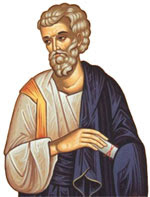
St. Ephraim of Syria
Reading:
Saint Ephraim was born in Nisibis of Mesopotamia some time about the year 306, and in his youth was the disciple of Saint James, Bishop of Nisibis, one of the 318 Fathers at the First Ecumenical Council. Ephraim lived in Nisibis, practicing a severe ascetical life and increasing in holiness, until 363, the year in which Julian the Apostate was slain in his war against the Persians, and his successor Jovian surrendered Nisibis to them. Ephraim then made his dwelling in Edessa, where he found many heresies to do battle with. He waged an especial war against Bardaisan; this gnostic had written many hymns propagating his errors, which by their sweet melodies became popular and enticed souls away from the truth. Saint Ephraim, having received from God a singular gift of eloquence, turned Bardaisan's own weapon against him, and wrote a multitude of hymns to be chanted by choirs of women, which set forth the true doctrines, refuted heretical error, and praised the contests of the Martyrs.
Of the multitude of sermons, commentaries, and hymns that Saint Ephraim wrote, many were translated into Greek in his own lifetime. Sozomen says that Ephraim "Surpassed the most approved writers of Greece," observing that the Greek writings, when translated into other tongues, lose most of their original beauty, but Ephraim's works "are no less admired when read in Greek than when read in Syriac" (Eccl. Hist., Book 111, 16). Saint Ephraim was ordained deacon, some say by Saint Basil the Great, whom Sozomen said "was a great admirer of Ephraim, and was astonished at his erudition." Saint Ephraim was the first to make the poetic expression of hymnody and song a vehicle of Orthodox theological teachings, constituting it an integral part of the Church's worship; he may rightly be called the first and greatest hymnographer of the Church, who set the pattern for these who followed him, especially Saint Romanos the Melodist. Because of this he is called the "Harp of the Holy Spirit." Jerome says that his writings were read in some churches after the reading of the Scriptures, and adds that once he read a Greek translation of one of Ephraim's works, "and recognized, even in translation, the incisive power of his lofty genius" (De vir. ill., ch. CXV).
Shortly before the end of his life, a famine broke out in Edessa, and Saint Ephraim left his cell to rebuke the rich for not sharing their goods with the poor. The rich answered that they knew no one to whom they could entrust their goods. Ephraim asked them, "What do you think of me?" When they confessed their reverence for him, he offered to distribute their alms, to which they agreed. He himself cared with his own hands for many of the sick from the famine, and so crowned his life with mercy and love for neighbor. Saint Ephraim reposed in peace, according to some in the year 373, according to others, 379.
Apolytikion in the Fourth Tone
With the rivers of your tears, you have made the barren desert fertile. Through sighs of sorrow from deep within you, your labors have borne fruit a hundred-fold. By your miracles you have become a light, shining upon the world. O Ephraim, our Holy Father, pray to Christ our God, to save our souls.
Kontakion in the Second Tone
At all times didst thou foresee the hour of reckoning, and pricked in thy heart, thou ever didst lament with tears; and, O righteous Ephraim, thou wast a mighty teacher in works and deeds. Hence, O Father for all the world, thou didst rouse the slothful unto change of heart.
Mar Isaac the Syrian
Apolytikion in the Plagal of the First Tone
He that thundered on Sinai with saving laws for man hath also given thy writings as guides in prayer unto monks, O revealer of unfathomable mysteries; for having gone up in the mount of the vision of the Lord, thou wast shown the many mansions. Wherefore, O God-bearing Isaac, entreat the Saviour for all praising thee.
Kontakion in the Plagal of the Fourth Tone
As an ascetic and God-bearer great in righteousness and an instructor of monastics do we honour thee, thou revealer of things sacred, and our protector. But, O Isaac, since thou hast great boldness with the Lord, intercede with Him for all of us who sing thy praise and who cry to thee: Rejoice, O Father most wise in God.
Readings courtesy of Holy Transfiguration Monastery
"A small but always persistent discipline is a great force; for a soft drop falling persistently, hollows out hard rock."- Mar Isaac of Syria
Showing posts with label Mar Isaac. Show all posts
Showing posts with label Mar Isaac. Show all posts
Wednesday, January 28, 2009

Tuesday, April 29, 2008
A Rant about Monarchy, some other stuff
So I noticed on CAF that there was a poster calling it "Anti American" to kiss a Bishop's ring because it acknowledges "royal status". Oh how Leo XIII is rolling in his grave because of Americanist comments like that.
Been ahwile since I have updated this but I suppose I need to keep all 0 of my readers up to date.
"Once someone has doubted God's care for him, he immediately falls into a myriad of anxieties." - Mar Isaac the Syrian
This is my Isaac of Syria quote of the week (and by week I mean until I think to add another quote). This is a very true statement, even the least amount of doubt will take one down from a very high level spiritual union. It eats away at the person slowly at first until it makes a decisive attack and drags one down to despair. Saint Claude de la colombiere says that we need to attack the passions at the first sign of trouble, even if its the most slightiest passion, such as a desire to hang out with friends rather then follow your prayer schedule. The same could be applied to fighting doubts. Spiritual warfare is "serious business" to borrow a well known internet meme. If you get a slight wound, you don't just keep walking it off until you start getting to a critical condition of blood loss. You seek treatment to restore your health and this treatment is of course. The physician does not seek patients who are well, but those that are ill and this physician of course if Christ. Therefore a trip to the doctor is in order at the first sign of trouble, not at the last second. This is, I beleive, something that many people (including myself) fail to do constantly. Anyways, sorry I am kind of ranting and not really making too much of a point (blame the david bowie music I am listening to in the background). Anyways perhaps the next post will be more coherant.
JMJ
Been ahwile since I have updated this but I suppose I need to keep all 0 of my readers up to date.
"Once someone has doubted God's care for him, he immediately falls into a myriad of anxieties." - Mar Isaac the Syrian
This is my Isaac of Syria quote of the week (and by week I mean until I think to add another quote). This is a very true statement, even the least amount of doubt will take one down from a very high level spiritual union. It eats away at the person slowly at first until it makes a decisive attack and drags one down to despair. Saint Claude de la colombiere says that we need to attack the passions at the first sign of trouble, even if its the most slightiest passion, such as a desire to hang out with friends rather then follow your prayer schedule. The same could be applied to fighting doubts. Spiritual warfare is "serious business" to borrow a well known internet meme. If you get a slight wound, you don't just keep walking it off until you start getting to a critical condition of blood loss. You seek treatment to restore your health and this treatment is of course. The physician does not seek patients who are well, but those that are ill and this physician of course if Christ. Therefore a trip to the doctor is in order at the first sign of trouble, not at the last second. This is, I beleive, something that many people (including myself) fail to do constantly. Anyways, sorry I am kind of ranting and not really making too much of a point (blame the david bowie music I am listening to in the background). Anyways perhaps the next post will be more coherant.
JMJ
Thursday, March 27, 2008
Wisdom from the mouth of Mar Isaac the Syrian

"Will God, if I ask, forgive me these things by which I am pained and by whose memory I am tormented, things by which, though I abhor them, I go on backsliding? Yet after they have taken place the pain the give me is even greater than that of a scorpion’s sting. Though I abhor them, I am still in the middle of them, and when I repent of them with suffering I wretchedly return to them again.” This is how many God-fearing people think, people who foster virtue and are pricked with the suffering of compunction, who mourn over their sin; yet human prosperity compels them to bear with the backsliding which results from it. They live between sin and repentance all the time. Let us not be in doubt, O fellow humanity, concerning the hope of our salvation, seeing that the One who bore sufferings for our sakes is very concerned about our salvation; God’s mercifulness is far more extensive than we can conceive, God’s grace is greater than what we ask for. "
"In love did God bring the world into existence; in love is God going to bring it to that wondrous transformed state, and in love will the world be swallowed up in the great mystery of the One who has performed all these things; in love will the whole course of the governance of creation be finally comprised. "
"As for me I say that those who are tormented in hell are tormented by the invasion of love. What is there more bitter and violent than the pains of love? Those who feel they have sinned against love bear in themselves a damnation much heavier than the most dreaded punishments. The suffering with which sinning against love afflicts the heart is more keenly felt than any other torment. It is absurd to assume that the sinners in hell are deprived of God’s love. Love is offered impartially. But by its very power it acts in two ways. It torments sinners, as happens here on earth when we are tormented by the presence of a friend to whom we have been unfaithful. And it gives joy to those who have been faithful. That is what the torment of hell is in my opinion: remorse. But love inebriates the souls of the sons and daughters of heaven by its delectability. "
Subscribe to:
Posts (Atom)
Blessed Constantine XI

Mar Isaac of Syria

St. Gregory Palamas