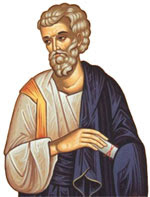
January 28
St. Ephraim of Syria
Reading:
Saint Ephraim was born in Nisibis of Mesopotamia some time about the year 306, and in his youth was the disciple of Saint James, Bishop of Nisibis, one of the 318 Fathers at the First Ecumenical Council. Ephraim lived in Nisibis, practicing a severe ascetical life and increasing in holiness, until 363, the year in which Julian the Apostate was slain in his war against the Persians, and his successor Jovian surrendered Nisibis to them. Ephraim then made his dwelling in Edessa, where he found many heresies to do battle with. He waged an especial war against Bardaisan; this gnostic had written many hymns propagating his errors, which by their sweet melodies became popular and enticed souls away from the truth. Saint Ephraim, having received from God a singular gift of eloquence, turned Bardaisan's own weapon against him, and wrote a multitude of hymns to be chanted by choirs of women, which set forth the true doctrines, refuted heretical error, and praised the contests of the Martyrs.
Of the multitude of sermons, commentaries, and hymns that Saint Ephraim wrote, many were translated into Greek in his own lifetime. Sozomen says that Ephraim "Surpassed the most approved writers of Greece," observing that the Greek writings, when translated into other tongues, lose most of their original beauty, but Ephraim's works "are no less admired when read in Greek than when read in Syriac" (Eccl. Hist., Book 111, 16). Saint Ephraim was ordained deacon, some say by Saint Basil the Great, whom Sozomen said "was a great admirer of Ephraim, and was astonished at his erudition." Saint Ephraim was the first to make the poetic expression of hymnody and song a vehicle of Orthodox theological teachings, constituting it an integral part of the Church's worship; he may rightly be called the first and greatest hymnographer of the Church, who set the pattern for these who followed him, especially Saint Romanos the Melodist. Because of this he is called the "Harp of the Holy Spirit." Jerome says that his writings were read in some churches after the reading of the Scriptures, and adds that once he read a Greek translation of one of Ephraim's works, "and recognized, even in translation, the incisive power of his lofty genius" (De vir. ill., ch. CXV).
Shortly before the end of his life, a famine broke out in Edessa, and Saint Ephraim left his cell to rebuke the rich for not sharing their goods with the poor. The rich answered that they knew no one to whom they could entrust their goods. Ephraim asked them, "What do you think of me?" When they confessed their reverence for him, he offered to distribute their alms, to which they agreed. He himself cared with his own hands for many of the sick from the famine, and so crowned his life with mercy and love for neighbor. Saint Ephraim reposed in peace, according to some in the year 373, according to others, 379.
Apolytikion in the Fourth Tone
With the rivers of your tears, you have made the barren desert fertile. Through sighs of sorrow from deep within you, your labors have borne fruit a hundred-fold. By your miracles you have become a light, shining upon the world. O Ephraim, our Holy Father, pray to Christ our God, to save our souls.
Kontakion in the Second Tone
At all times didst thou foresee the hour of reckoning, and pricked in thy heart, thou ever didst lament with tears; and, O righteous Ephraim, thou wast a mighty teacher in works and deeds. Hence, O Father for all the world, thou didst rouse the slothful unto change of heart.
Mar Isaac the Syrian
Apolytikion in the Plagal of the First Tone
He that thundered on Sinai with saving laws for man hath also given thy writings as guides in prayer unto monks, O revealer of unfathomable mysteries; for having gone up in the mount of the vision of the Lord, thou wast shown the many mansions. Wherefore, O God-bearing Isaac, entreat the Saviour for all praising thee.
Kontakion in the Plagal of the Fourth Tone
As an ascetic and God-bearer great in righteousness and an instructor of monastics do we honour thee, thou revealer of things sacred, and our protector. But, O Isaac, since thou hast great boldness with the Lord, intercede with Him for all of us who sing thy praise and who cry to thee: Rejoice, O Father most wise in God.
Readings courtesy of Holy Transfiguration Monastery
"A small but always persistent discipline is a great force; for a soft drop falling persistently, hollows out hard rock."- Mar Isaac of Syria
Showing posts with label Ephrem the Syrian. Show all posts
Showing posts with label Ephrem the Syrian. Show all posts
Wednesday, January 28, 2009

Tuesday, April 8, 2008
Mar Ephrem's hymns on Virginity I-11
I. PUT off, O Body, that Old Man which is altogether hateful, that it may not wear out the newness that thou inhabitest and hast put on ; for the recompense of its interest is contrary with its clothes, in that if thou hast been renewed it will return and wear thee out : O Body, hear my counsels ! Put it off by (good) conduct, that it may not clothe thee in (bad) habits.
II. For, lo, our Lord has made thee, O Body, new in water, and the Architect of Life has built thy oldness, in that He formed with His Blood and built for it a shrine for His habitation ; do [P. 171.] not let dwell instead of Him that Old Man in the shrine He has renewed : O Body, if thou dost make God to stay in thy shrine, thou also wilt be a temple of His kingdom and a priest of His sacrifice.
III. For this Old Man is reproved by Nature that teaches and the Book that proclaims, for its wickedness is between two just things, that if it sins in respect of what is without law, its Nature will reprove it, and if it sins in respect of law, the Book will reprove it. Lo, it wounds and they heal; on the track of wickedness they bring in regret, whereby he that sins is healed.
IV. Him that rebels they treat with contempt, and him that returns they bind up his wounds; they justify the Judge, they reprove the rebels, they care for and heal those who return : for they know that they will be measured with one Evil one, who hurts everything, who is fresh in every generation, and is a companion to every one, and hurts every hour ; they also are companions to every one, and are fresh in every generation, and are found at every hour.
V. Hearken to Nature and Law declaring his evil corruptions ! For the People (of Israel) who committed adultery under the Law, [P. 172.] and the Peoples who fornicated without Law, changed their Nature and behaved contrary to their Nature ; Nature and Law have appealed against him, whose dispositions the Disturber has corrupted.
VI. The humble ones have stolen away from marriage under pretext of discipleship, and when they are halfway he (the 'Old Man') has set behind them the shame of stumbling and in front of them hateful desire ; being ashamed to revert to marriage, they fall and are taken in the snares.
VII. How light are thy wings, O Virginity, that soar and go up to where thy Bridegroom sits at the right hand of the Lord of the Heights ! Flee from the counsel of the deceiver, for he who apportions debt to the inexperienced is wont to cast his whole property for nothing to the loss of the merchants (?).
VIII. He impoverished the treasures of great Adam, who with his money acquired a weight of debt. O Body, do not borrow from him that does not ask back what he has lent, that if thou pay him his silver the debt impoverishes.
IX. For accompanying its desires are apprehension and [P. 173.] doubt and contempt with disgrace, and they reject and give pain to the doers of them, and the faces only are open and pure of the chaste ones who have put it (? the 'old man') off ; do not be joined, O Body, with hateful love, of which however much the deed is dead, the anxiety of it lives secretly.
II. For, lo, our Lord has made thee, O Body, new in water, and the Architect of Life has built thy oldness, in that He formed with His Blood and built for it a shrine for His habitation ; do [P. 171.] not let dwell instead of Him that Old Man in the shrine He has renewed : O Body, if thou dost make God to stay in thy shrine, thou also wilt be a temple of His kingdom and a priest of His sacrifice.
III. For this Old Man is reproved by Nature that teaches and the Book that proclaims, for its wickedness is between two just things, that if it sins in respect of what is without law, its Nature will reprove it, and if it sins in respect of law, the Book will reprove it. Lo, it wounds and they heal; on the track of wickedness they bring in regret, whereby he that sins is healed.
IV. Him that rebels they treat with contempt, and him that returns they bind up his wounds; they justify the Judge, they reprove the rebels, they care for and heal those who return : for they know that they will be measured with one Evil one, who hurts everything, who is fresh in every generation, and is a companion to every one, and hurts every hour ; they also are companions to every one, and are fresh in every generation, and are found at every hour.
V. Hearken to Nature and Law declaring his evil corruptions ! For the People (of Israel) who committed adultery under the Law, [P. 172.] and the Peoples who fornicated without Law, changed their Nature and behaved contrary to their Nature ; Nature and Law have appealed against him, whose dispositions the Disturber has corrupted.
VI. The humble ones have stolen away from marriage under pretext of discipleship, and when they are halfway he (the 'Old Man') has set behind them the shame of stumbling and in front of them hateful desire ; being ashamed to revert to marriage, they fall and are taken in the snares.
VII. How light are thy wings, O Virginity, that soar and go up to where thy Bridegroom sits at the right hand of the Lord of the Heights ! Flee from the counsel of the deceiver, for he who apportions debt to the inexperienced is wont to cast his whole property for nothing to the loss of the merchants (?).
VIII. He impoverished the treasures of great Adam, who with his money acquired a weight of debt. O Body, do not borrow from him that does not ask back what he has lent, that if thou pay him his silver the debt impoverishes.
IX. For accompanying its desires are apprehension and [P. 173.] doubt and contempt with disgrace, and they reject and give pain to the doers of them, and the faces only are open and pure of the chaste ones who have put it (? the 'old man') off ; do not be joined, O Body, with hateful love, of which however much the deed is dead, the anxiety of it lives secretly.
X. Subtle and cunning is his (the 'Old Man's') discipleship, in that by all sorts (of means) he will be bestowing his gifts upon the good. The mouth of the poor he stops with his bread ; with his free meals he sells free-men into slavery. The belly he has bribed and it has been corrupted ; (he has bribed) the eye to overlook, and the mouth to keep silence, and the ear to make his hateful reports. His silent wine is talkative in those that drink it; it babbles in their voices instead of its master.
XI. For he is cunning, in that first he puts on the mouth of his. snare food as a bait; his love goes in front of his corruption, like Judas, who kissed and killed. The Pure One kissed the unclean, to teach that his kisses are a poison and death is moulded by them secretly ; this is one who if thou raise him up will recompense thee with a fall, who when he rises lulls to sleep, the desire of whom is deadly. And thy own flesh makes it live and resurrects it (this desire), and when it is alive therein it turns and kills it. O Body, if thou give life to deadness, there will be death also for thy life.
http://www.tertullian.org/fathers/ephraim2_6_virginity.htm
ܡܪܝ ܐܦܪܝܡ ܣܘܪܝܝܐ Mar Ephrem the Sryian
Subscribe to:
Posts (Atom)
Blessed Constantine XI

Mar Isaac of Syria

St. Gregory Palamas